What is Marketing Cloud Account Engagement
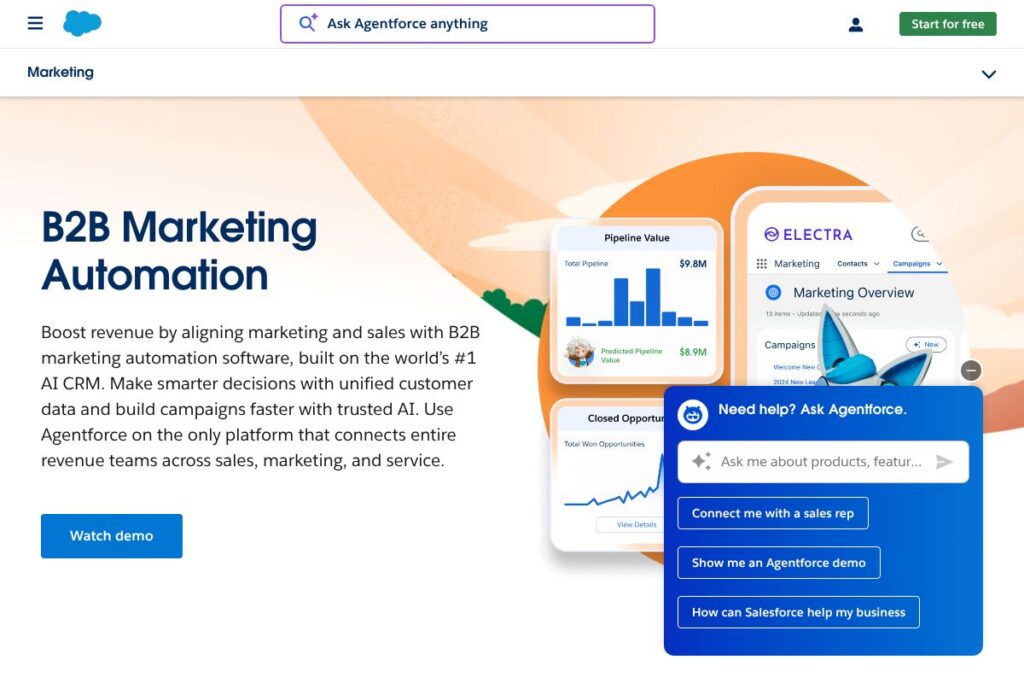
Marketing Cloud Account Engagement is a B2B marketing automation solution built on the Salesforce platform, designed to align marketing, sales, and service around shared customer data. It combines campaign orchestration, lead and account scoring, AI-assisted content generation via Agentforce, and analytics that surface how marketing influences pipeline and revenue.
Compared with HubSpot Marketing Hub, Marketing Cloud Account Engagement emphasizes deeper native CRM integration and account-based workflows that scale across enterprise sales organizations. Compared with Adobe Marketo Engage, it offers tighter linkage with Salesforce data and built-in AI scoring from Einstein, while Marketo is often chosen for complex cross-vendor marketing stacks. Compared with Oracle Eloqua, Account Engagement typically appeals to teams that already use Salesforce as their primary CRM and want native, real-time data sharing between marketing and sales.
All of this makes Marketing Cloud Account Engagement a strong fit for B2B marketing teams that need account-based marketing at scale, want real-time CRM integration, and prefer AI-assisted campaign creation with human oversight. It performs particularly well when marketing and sales must share engagement signals and act on the same account-level intelligence.
How Marketing Cloud Account Engagement Works
Marketing Cloud Account Engagement sits on top of Salesforce CRM, ingesting CRM records and engagement events to build unified account and lead profiles. Marketers create multi-step journeys, landing pages, and forms that capture interactions, and the platform shares those signals in real time with sales and service teams to trigger follow-up and pipeline actions.
Agentforce uses natural language prompts to assemble campaign briefs, audiences, journey maps, and draft content, while Einstein provides AI-driven lead and account scoring and multi-touch attribution. Typical workflows include building a targeted account list, launching personalized email and SMS sequences, alerting reps when high-value buyers engage, and tracking influenced pipeline on dashboards.
Marketing Cloud Account Engagement features
Marketing Cloud Account Engagement centers on account-based orchestration, AI-assisted campaign creation, and native Salesforce integration. Core capabilities include Agentforce for campaign generation, Einstein scoring and attribution for prioritization and measurement, multi-channel journeys including SMS and WhatsApp, drag-and-drop landing pages and forms, and account-based dashboards that track pipeline influence.
The platform includes several powerful capabilities worth highlighting:
Agentforce campaign creation
Agentforce accelerates campaign setup with natural language prompts that produce briefs, segmentation suggestions, journey outlines, and draft content. This reduces planning time and helps teams iterate on campaigns faster while keeping marketers in the loop to refine tone and brand messaging.
Unified customer data (Data 360)
Data 360 centralizes CRM records, engagement signals, and third-party activity so campaigns are grounded in real-time account and contact data. Sharing those signals across sales and service teams ensures consistent context for outreach and faster lead follow-up.
Multi-channel journeys
Create automated, cross-channel journeys that combine email, SMS, WhatsApp, and web interactions using drag-and-drop builders. The capability makes it easier to send just-in-time messages for events, upsells, and surveys while maintaining consistent personalization across channels.
Forms and landing pages with AI
The platform provides drag-and-drop builders plus AI-assisted copy suggestions for landing pages and forms to speed lead capture. Built-in form analytics and progressive profiling help reduce friction and improve conversion rates for targeted campaigns.
AI lead and account scoring (Einstein)
Einstein scoring and grading rank leads and accounts by conversion likelihood based on interaction patterns and CRM signals. These scores help sales prioritize outreach and let marketing optimize nurture paths for accounts with the highest potential.
Account-based marketing dashboards
Prebuilt account-based dashboards show pipeline influence, engagement across buying committees, and campaign performance by account. Teams can use these dashboards to tune ABM strategies and share insights with sales for coordinated outreach.
Multi-touch attribution (Einstein Attribution)
Einstein Attribution offers native multi-touch models to quantify how channels and events contribute to pipeline. Marketers can compare models, measure ROI, and reallocate spend toward channels that drive measurable revenue.
With Marketing Cloud Account Engagement you get cohesive account-level orchestration, AI-driven prioritization, and native Salesforce integration that make it easier to coordinate revenue teams and measure marketing impact.
Marketing Cloud Account Engagement pricing
Marketing Cloud Account Engagement uses a subscription pricing model with annual contracts and multiple editions aimed at different business needs. Plans are sold per organization and billed annually, and each edition bundles Agentforce and platform capabilities with increasing scale and channel support.
Annual Billing:
Account Engagement+ – $1,250 USD/Org/Month (Billed annually) (Includes Marketing Cloud Growth or Advanced, Agentforce Campaign Creation, Lead Nurturing and Scoring, B2B Marketing Analytics)
Marketing Cloud Growth Edition – $1,500 USD/Org/Month (Billed annually) (Includes Agentforce Campaign Creation, Multi-Channel Journeys, Forms and Landing Pages)
Marketing Cloud Advanced Edition – $3,250 USD/Org/Month (Billed annually) (Includes Agentforce Campaign Creation, Path Experimentation, Two-Way Conversations for SMS and WhatsApp)
Monthly Billing:
Monthly billing is not published for these editions; Salesforce typically requires an annual contract for Marketing Cloud Account Engagement. For enterprise deployments and custom terms, consult Salesforce sales for tailored pricing and packaging via the Marketing Cloud Account Engagement product page.
For more details about specific edition limits, bundled features, and optional add-ons, review the Marketing Cloud Account Engagement overview on the Salesforce site and contact a sales representative for a quote. See the Marketing Cloud Account Engagement product overview for current edition information.
Marketing Cloud Account Engagement Use Cases
Marketing Cloud Account Engagement is commonly used for account-based marketing programs, where teams target and nurture named accounts through coordinated, personalized journeys. Sales and marketing use shared engagement signals to prioritize outreach, surface buying committees, and measure how marketing activities influence pipeline.
Other common uses include lead generation and nurture programs, event promotion and attendee follow-up using SMS and email, onboarding journeys for early-stage customers, and multi-touch attribution to understand channel impact. The platform suits B2B organizations that need to scale personalized engagement across accounts and align revenue teams on the same data.
Pros and Cons of Marketing Cloud Account Engagement
Pros
- Deep Salesforce integration: Built on Salesforce CRM, it shares real-time customer and account data across marketing, sales, and service for coordinated revenue actions. This tight connection reduces data sync gaps and speeds handoffs from marketing to sales.
- AI-driven scoring and content: Einstein and Agentforce provide AI-assisted scoring, attribution, and draft content which reduce manual work while letting marketers maintain control over messaging. These capabilities help prioritize high-potential accounts and accelerate campaign creation.
- Account-based focus: The platform includes ABM dashboards, account scoring, and pipeline tracking that support targeted, multi-stakeholder outreach. That makes it easier to run ABM programs with measurable revenue outcomes.
Cons
- Enterprise orientation and cost: Pricing and packaging are oriented toward medium and large organizations and require annual contracts, which can be expensive for smaller teams or startups. Customization and advanced modules may increase total cost of ownership.
- Salesforce dependency: The strongest capabilities depend on using Salesforce CRM; organizations on other CRMs may not get the same real-time integration benefits and could face more complex implementation work. Migration or integration requires planning and technical resources.
- Learning curve for advanced features: Advanced attribution, path experimentation, and account scoring require setup and governance to get reliable results, which can demand dedicated analytics and operations resources.
Does Marketing Cloud Account Engagement Offer a Free Trial?
Marketing Cloud Account Engagement is a paid subscription product with annual contracts and does not advertise a permanent free plan. Salesforce commonly provides demo options, guided trials via sales teams, and free training on Trailhead to help teams evaluate capabilities before purchase. For trial availability or demo scheduling, consult the Marketing Cloud Account Engagement product page and request a demo.
Marketing Cloud Account Engagement API and Integrations
Marketing Cloud Account Engagement provides developer APIs and native connectors to Salesforce CRM, enabling read and write access to CRM records, engagement events, and campaign data. The API documentation details endpoints for automating lead capture, syncing scoring, and pulling reporting data.
The platform also integrates with common marketing and webinar platforms, analytics tools, and hundreds of partner apps available in the Salesforce AppExchange. Key integrations include Google Workspace, webinar providers, CRM workflows in Salesforce Sales Cloud, and data connectors for BI and attribution reporting.
10 Marketing Cloud Account Engagement alternatives
Paid alternatives to Marketing Cloud Account Engagement
- HubSpot Marketing Hub — An all-in-one inbound marketing and CRM platform with built-in automation, content tools, and analytics suited to teams of varying sizes.
- Adobe Marketo Engage — Enterprise-grade marketing automation with strong lead management, advanced nurturing, and deep marketing analytics for complex organizations.
- Oracle Eloqua — A marketing automation platform focused on enterprise B2B marketers who need complex segmentation and program orchestration across channels.
- ActiveCampaign — A combined CRM and automation platform that offers flexible workflows and messaging for small to mid-market teams.
- Salesloft — Sales engagement platform that pairs well with marketing automation for outreach orchestration and buyer engagement insights.
- Outreach — Sales engagement and sequencing platform that complements marketing automation by operationalizing sales touches on engaged accounts.
- Iterable — Growth marketing platform that supports cross-channel messaging and personalization at scale for B2C and B2B use cases.
Open source alternatives to Marketing Cloud Account Engagement
- Mautic — Open source marketing automation for building campaigns, forms, and multi-channel messaging with self-hosted control. It supports segmentation and basic lead scoring.
- OpenEMM — Open source email marketing and campaign platform that focuses on email deliverability, list management, and reporting.
- CiviCRM — Open source CRM with marketing and email capabilities aimed at non-profits and associations, offering segmented outreach and contribution tracking.
Frequently asked questions about Marketing Cloud Account Engagement
What is Marketing Cloud Account Engagement used for?
Marketing Cloud Account Engagement is used to run B2B marketing and account-based programs. Teams use it to capture leads, score and nurture accounts, orchestrate multi-channel journeys, and measure marketing influence on pipeline.
Does Marketing Cloud Account Engagement integrate with Salesforce CRM?
Yes, it is built natively on Salesforce and integrates in real time with Salesforce CRM. That integration shares account and contact data, engagement events, and scores between marketing and sales.
How much does Marketing Cloud Account Engagement cost?
Pricing is subscription-based with annual contracts and starts at the listed edition prices for organizations. Editions include Account Engagement+ at $1,250 USD/Org/Month, Marketing Cloud Growth Edition at $1,500 USD/Org/Month, and Marketing Cloud Advanced Edition at $3,250 USD/Org/Month, all billed annually.
Can Marketing Cloud Account Engagement do account-based marketing?
Yes, it includes ABM capabilities such as account scoring, targeted journeys, and account-based dashboards. These features help identify buying committees and measure account-level pipeline influence.
Does Marketing Cloud Account Engagement offer APIs for automation?
Yes, it provides APIs and developer documentation for programmatic access to leads, activities, and campaign data. See the Marketing Cloud Account Engagement API documentation for endpoints and integration guidance.
Final Verdict: Marketing Cloud Account Engagement
Marketing Cloud Account Engagement stands out for organizations that run B2B and account-based marketing and also use Salesforce CRM as their system of record. Its strengths are native CRM integration, AI-driven scoring and campaign generation through Agentforce and Einstein, and built-in measurement for account-level pipeline influence.
Compared with HubSpot Marketing Hub, Marketing Cloud Account Engagement is priced and positioned for mid-market and enterprise teams that need deep Salesforce alignment; its editions start at $1,250 USD/Org/Month billed annually and focus on account-based orchestration and AI scoring. For teams already invested in Salesforce and needing close sales-marketing alignment, it delivers significant operational benefits, while smaller teams or organizations without Salesforce may find competitor platforms more cost-effective.
Overall, Marketing Cloud Account Engagement is a comprehensive B2B marketing automation choice for revenue teams that require account-level orchestration, AI-driven prioritization, and tight integration with Salesforce CRM. For demos, pricing customizations, and edition comparisons, request a demo or contact Salesforce sales through the Marketing Cloud Account Engagement product page.