What is Moosend
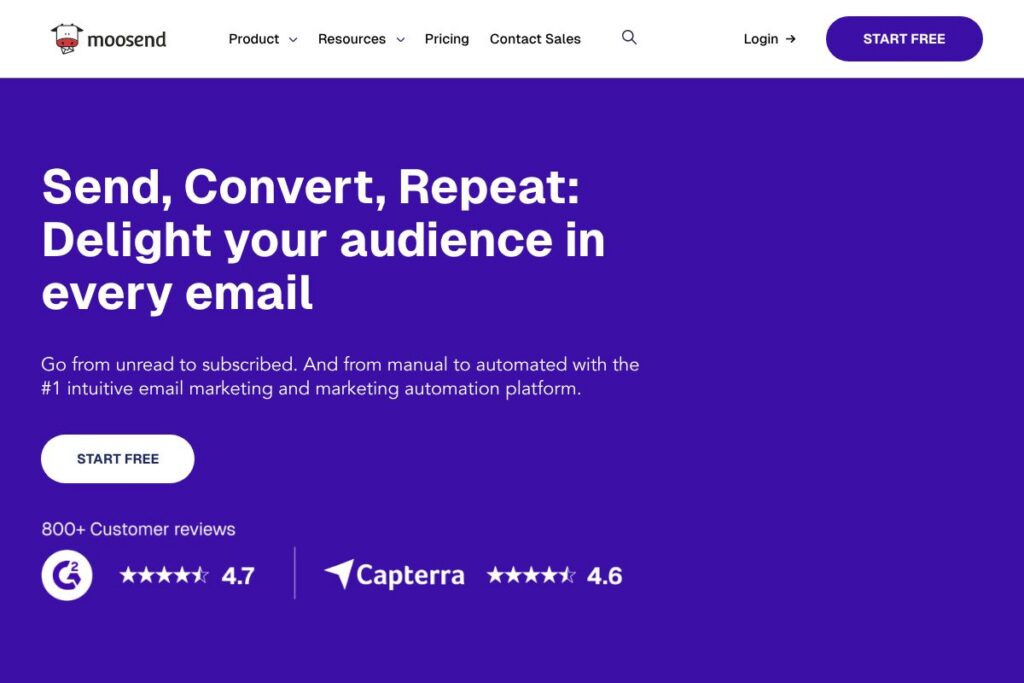
Moosend is an email marketing and automation platform focused on helping teams send targeted email campaigns, build automated customer journeys, and measure campaign performance. It combines a visual campaign builder, automation workflows, segmentation, and reporting in one interface so marketers can move from manual sends to data-driven automation.
Compared with Mailchimp, Moosend places a stronger emphasis on straightforward automation workflows and value pricing for growing lists. Against ActiveCampaign, Moosend offers a simpler user experience with many comparable automation and personalization features but with fewer advanced CRM capabilities. Compared to Sendinblue, Moosend provides a similar mix of email, forms, and landing pages while also including SMTP relay and AI-assisted content tools that reduce setup time.
All of this makes Moosend especially useful for small and mid-market teams that want to deploy automated email journeys and landing pages without a large implementation effort. The platform works well for e-commerce stores, membership organizations, and agencies that manage multiple client campaigns.
How Moosend Works
Moosend organizes work around campaigns, audiences, and automation workflows. You import or capture subscribers, segment them with rules or tags, and then use a drag-and-drop editor to design emails and landing pages. Automation workflows trigger sends based on events, subscriber behavior, or time delays so recurring tasks can be set and left running.
Typical implementations start with a subscription form or landing page to capture leads, then route those leads into a welcome automation that scores engagement and branches to personalized messages. Teams use A/B testing and real-time reports to iterate on subject lines, content, and send times, while SMTP relay and deliverability tools help maintain inbox placement during scale-ups.
What does Moosend do?
Moosend centralizes email campaign creation, automated workflows, and audience growth tools so you can run multi-step journeys and conversion-focused campaigns from a single dashboard. Core capabilities include a visual email editor, automation builder, A/B testing, landing page templates, subscription forms, SMTP server access, and analytics for opens, clicks, and conversions.
Key functionality includes:
Automation Workflows
Create visual, event-driven automation sequences for welcome flows, cart recovery, re-engagement, and lead nurturing. Automations can branch on behavior, wait for set periods, and update subscriber fields, which helps reduce manual segmentation and increase conversion consistency.
Segmentation and Personalization
Segment lists using custom fields, behavior, and engagement metrics to deliver targeted content. Dynamic content blocks let you personalize subject lines and email sections based on subscriber attributes so messages stay relevant across audiences.
A/B Testing
Run multivariate or split tests for subject lines, from names, and email content to determine what drives the best open and conversion rates. Test results feed into optimization decisions so teams can scale the most effective variants.
Email Editor and Templates
Use a drag-and-drop editor with ready-made, customizable templates to speed up creative production. Template and component reuse reduces design time, and inline editing helps non-technical users maintain brand consistency across campaigns.
Landing Pages and Subscription Forms
Build landing pages and forms with templates and a visual builder to capture leads without coding. Forms can push subscribers directly into automations and include custom fields to gather preference data for deeper personalization.
SMTP Relay and Deliverability Tools
Send transactional or high-volume messages through Moosend’s SMTP server to maintain deliverability and improve inbox placement. Relay options and deliverability monitoring make it easier to scale sends while tracking bounce rates and sender reputation.
Real-Time Reporting and Analytics
Monitor open rates, click-throughs, revenue attribution, and automation performance with real-time dashboards. Reporting helps teams identify drop-off points in journeys and measure ROI for specific campaigns and segments.
AI-Assisted Content
Leverage built-in AI tools to generate subject lines or copy suggestions that match your tone and audience. AI features speed up content creation and provide starting points for testing different messaging approaches.
With these capabilities, the biggest benefit of Moosend is simplified automation that reduces repetitive work while keeping personalization options accessible to non-developers.
Moosend pricing
Moosend uses a subscription pricing model with discounts for semiannual and annual billing; the vendor highlights automatic savings for paying twice a year or once a year, but exact plan prices and seat thresholds are listed on the vendor site. Plans generally scale by subscriber count and include features such as automation, landing pages, SMTP relay, and reporting depending on the tier.
Pricing details and plans
For current plan options and the latest billing discounts, view the Moosend homepage where the vendor displays available billing cycles and savings. If you need enterprise features or custom SLAs, contact Moosend sales through the same site to discuss tailored pricing and deployment options.
What is Moosend Used For?
Moosend is commonly used to run marketing email programs that combine campaigns and automated journeys, including welcome series, cart abandonment sequences, and re-engagement flows. Teams use landing pages and subscription forms to capture leads, then route those leads into personalized automations based on behavior and profile data.
It is also useful for transactional email via SMTP relay, simple CRM-like segmentation for e-commerce, and agency-managed accounts where multiple client campaigns must be handled from one platform. The platform is suited to marketing teams that need depth in automation without heavy technical setup.
Pros and Cons of Moosend
Pros
- Accessible automation: The visual workflow builder makes it straightforward to create welcome flows, cart recovery, and multi-step campaigns without coding or developer support. This reduces time to launch and keeps non-technical teams productive.
- Comprehensive growth tools: Forms, landing pages, and SMTP relay are included so teams can capture leads, send transactional messages, and run campaigns from one platform. Combining these features eliminates the need for separate vendors in many setups.
- AI-assisted content and testing: Built-in AI suggestions and A/B testing capabilities speed content creation and optimization, helping teams iterate faster on subject lines and message variants.
Cons
- Advanced CRM limitations: While Moosend handles segmentation and automation well, it lacks the deeper CRM and sales automation features found in platforms like ActiveCampaign or full marketing suites. Organizations needing lead scoring tied to sales pipelines may require additional tools.
- Limited public pricing transparency: The vendor emphasizes discounts for semiannual and annual billing, but plan details and thresholds are shown on the vendor site which can make initial comparisons slower for buyers evaluating multiple providers.
Does Moosend Offer a Free Trial?
Moosend offers a free plan and free trials for paid features. The free options allow you to test campaign creation, automation workflows, forms, and landing pages, while trial periods and feature limits vary by account type; check the Moosend homepage to see the current free plan terms and trial availability.
Moosend API and Integrations
Moosend provides developer APIs and webhooks for programmatic access to contacts, campaigns, and lists; the Moosend API documentation explains available endpoints and authentication methods. This enables integrations for sign-up flows, CRM synchronization, and custom automation triggers.
Common native and third-party integrations include e-commerce platforms, CMSs, and automation connectors such as Zapier, which help push events into Moosend workflows and pull campaign metrics into external dashboards. Check the documentation and help center for connector specifics and setup guides.
10 Moosend alternatives
Paid alternatives to Moosend
- Mailchimp — A broadly used platform with campaign tools, audiences, and automation; good for teams that want an all-in-one marketing suite with many built-in integrations.
- ActiveCampaign — Focuses on deep automation and CRM features, suited for teams that require sales-marketing alignment and advanced segmentation.
- Sendinblue — Combines email, SMS, and transactional messaging with a focus on deliverability and pay-as-you-go options for sending volumes.
- Constant Contact — Offers easy-to-use email tools and event management features that work well for small businesses and nonprofits.
- Klaviyo — Designed for e-commerce with strong revenue attribution, segmentation, and integration with major storefronts.
- HubSpot Marketing Hub — Part of a broader CRM platform, useful for teams that need native CRM, attribution, and full-funnel marketing capabilities.
Open source alternatives to Moosend
- Mautic — Open source marketing automation with campaign builder, forms, and tracking that you can self-host or run through managed providers.
- Mailtrain — Self-hosted newsletter app built on Node.js and MySQL, suitable for teams that want control over data and sending infrastructure.
- Listmonk — Modern, high-performance self-hosted newsletter and mailing list manager with fast delivery and API-first design.
- OpenEMM — Enterprise-capable open source email marketing and automation software that supports large-scale sending and reporting.
Frequently asked questions about Moosend
What is Moosend used for?
Moosend is used for email campaigns, automation workflows, and lead capture. Teams run targeted email sequences, build landing pages, and use forms to convert visitors into subscribers and customers.
Does Moosend have an API?
Yes, Moosend provides APIs and webhooks for developers. The Moosend API documentation covers endpoints for contacts, campaigns, and lists to enable custom integrations.
Can Moosend send transactional emails?
Yes, Moosend supports SMTP relay for transactional email. You can send order confirmations, receipts, and other transactional messages alongside marketing campaigns using the platform’s SMTP features.
How does Moosend handle A/B testing?
Moosend offers A/B split testing for subject lines and content variants. Tests help identify higher-performing variants for opens and clicks so you can automatically scale the winning version.
Is Moosend suitable for e-commerce stores?
Yes, Moosend is suitable for e-commerce use cases. Integrations, automation sequences for cart recovery, and revenue tracking make it a practical option for merchants focused on email-driven revenue.
Final verdict: Moosend
Moosend is a practical choice for teams that need a focused email marketing and automation tool with landing pages, subscription forms, SMTP relay, and AI-assisted content. It excels at simplifying automation setup and offering a unified place to capture leads and run campaigns without heavy technical overhead.
Compared with Mailchimp, Moosend typically presents a simpler automation interface and discounts for semiannual or annual billing which can be advantageous for growing lists; Mailchimp offers a wider marketplace of integrations and add-ons but can be more complex for automation novices. For organizations prioritizing straightforward automation, deliverability controls, and bundled growth tools, Moosend is a solid option worth testing via the vendor site and documentation.