What is Bandwidth
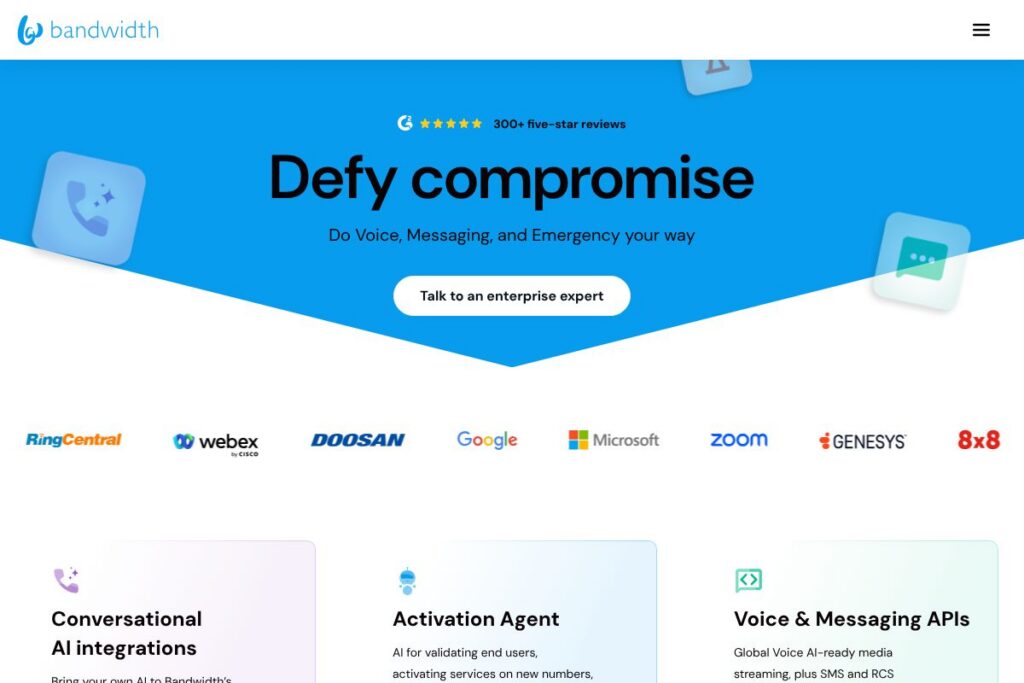
Bandwidth is an enterprise communications provider that combines programmable voice and messaging APIs with carrier infrastructure and emergency services. The platform emphasizes direct-to-carrier connectivity through Bandwidth Maestro, enabling customers to provision numbers, route traffic, and manage compliance on a carrier-grade network rather than relying solely on third-party carriers. Visit Bandwidth’s main site to learn about their platform and global coverage.
Compared with competitors such as Twilio, Vonage, and Plivo, Bandwidth’s distinguishing factor is its carrier ownership and direct-to-carrier integrations. Twilio offers a broad developer ecosystem and public usage pricing through its developer platform, while Vonage focuses on unified communications and contact center integrations. Plivo competes on simple, cost-effective messaging and voice APIs for developers, but lacks the same depth of carrier assets that Bandwidth brings to enterprise-scale deployments.
All of this makes Bandwidth well suited for organizations that need high-volume, compliant communications with predictable routing and emergency services. It does particularly well for businesses that require number provisioning and porting at scale, integrated E911 support, and tight control over voice quality and routing. These strengths make it a practical choice for contact centers, fintechs, healthcare providers, and platforms embedding communications into their products.
How Bandwidth Works
Bandwidth exposes programmable REST APIs and SDKs for voice, messaging, and emergency services that developers embed into applications. When you create a voice flow or messaging workflow you call Bandwidth APIs to provision numbers, set up SIP trunks, configure call routing, and receive webhooks for events and delivery receipts. The platform also supports SIP trunking for PBX and contact center integrations, allowing traffic to flow between a customer’s infrastructure and Bandwidth’s carrier network.
A core operational difference is Bandwidth Maestro, which provides direct-to-carrier integrations and centralized management for routing, regulatory controls, and number lifecycle operations. In practice a contact center can provision DID ranges, apply emergency routing for E911, and monitor call quality from Bandwidth’s console while the application logic lives in the customer’s environment. Webhooks and SDKs let teams automate provisioning, scale messaging for verification or marketing campaigns, and integrate conversational AI like Google Cloud’s conversational services for customer interactions.
What does Bandwidth do?
Bandwidth combines programmable voice, messaging, emergency APIs, and carrier services into a single platform. Core capabilities include voice call control, SIP trunking, SMS and MMS messaging, E911 emergency routing, direct-to-carrier connectivity via Bandwidth Maestro, number provisioning and porting, and reporting tools for call analytics and compliance. The platform continues to expand carrier reach and integrations to support high-volume, enterprise use cases.
The platform includes several powerful capabilities:
Voice API
Programmable call control lets developers create inbound and outbound voice flows, play prompts, record calls, and manage conferencing at scale. The API supports PSTN connectivity and integrates with SIP trunks so existing PBX and contact center systems can connect directly to Bandwidth.
Messaging API
Messaging APIs handle SMS, MMS, and short codes with delivery receipts and concatenation support for longer messages. These APIs are commonly used for two-factor authentication, appointment reminders, and customer notifications with high throughput and carrier-grade delivery monitoring.
Emergency (E911) APIs
E911 support provides automatic emergency call routing and location handling that meets regulatory requirements for U.S. emergency services. This capability is essential for hosted voice systems, contact centers, and any application that needs certified emergency routing and address management.
Bandwidth Maestro (Direct-to-Carrier Integrations)
Bandwidth Maestro centralizes routing and direct carrier interconnects so customers can manage traffic across multiple carriers and geographies from a single control plane. The direct-to-carrier approach reduces intermediaries, improves routing predictability, and simplifies number lifecycle operations for enterprises.
SIP Trunking and Number Management
SIP trunk services connect on-premises PBX or cloud contact centers to Bandwidth’s network, providing scalable channels, number provisioning, and number porting. Number inventory and provisioning APIs speed deployment for large fleets of DIDs and help automate portability workflows.
Security and Compliance
Bandwidth maintains industry security and compliance controls, including SOC 2 practices and regulatory compliance for telecom services, to support enterprise risk and governance needs. These controls help organizations meet data handling and operational standards required by finance, healthcare, and government customers.
Analytics and Reporting
Real-time reporting and call detail records let teams monitor call quality, delivery rates, and usage patterns. Analytics tools support billing reconciliation, SLA monitoring, and operational troubleshooting for high-volume communications environments.
Integrations and SDKs
Bandwidth provides SDKs and developer tooling to integrate communications into web and mobile applications and supports integrations with contact center platforms and conversational AI vendors. These integrations simplify deployment in environments that already use CRM or contact center software.
With this set of features, Bandwidth’s biggest benefit is combining developer-friendly APIs with carrier-grade infrastructure and regulatory services. That mix reduces the operational burden for enterprises building large-scale voice and messaging systems while keeping direct control of routing and compliance.
Bandwidth pricing
Bandwidth uses enterprise and usage-based pricing tailored to carriers, large platforms, and high-volume customers rather than fixed public plans. Pricing is typically customized based on traffic volume, number inventory, feature set, and deployment needs.
For current pricing options and to request a custom quote, contact Bandwidth’s sales team through Bandwidth’s pricing and sales contact. Sales can provide detailed, usage-based estimates and discuss volume discounts, number porting fees, and service-level commitments.
What is Bandwidth Used For?
Bandwidth is commonly used to power contact centers, enterprise PBX replacements, two-factor authentication messaging, appointment and billing notifications, and mass-notification systems. Organizations embed Bandwidth APIs into web and mobile apps to send verification codes, route inbound calls to agents, and automate outbound campaigns while retaining control over number management and delivery.
The platform is also used by carriers and CPaaS providers that need direct carrier interconnects and a managed telephony backbone. Enterprises that handle regulated communications, such as healthcare, financial services, and public safety, use Bandwidth for its integrated E911, compliance controls, and predictable routing at scale.
Pros and Cons of Bandwidth
Pros
- Direct-to-carrier ownership: Provides predictable routing, reduced intermediaries, and the ability to manage carrier relationships directly for large-scale deployments.
- Strong emergency services (E911): Built-in emergency APIs and address management reduce compliance complexity for hosted voice and contact center deployments.
- Enterprise-grade SIP and number management: Robust SIP trunking, number provisioning, and porting APIs simplify migration from legacy telecom providers.
- Developer-focused APIs and tooling: REST APIs, SDKs, and webhooks support rapid integration into applications and automation of telecom operations.
- High-volume reliability: Designed to support large platforms and carriers with features for monitoring, reporting, and SLA-driven operations.
Cons
- Enterprise-focused pricing model: Custom and usage-based pricing can be less accessible for small teams or hobbyist developers that prefer transparent, self-serve plans.
- Steeper onboarding for small projects: The platform’s carrier-grade controls and compliance workflows may require more setup effort than developer-centric competitors for simple proof-of-concept work.
- Geographic coverage variability: While Bandwidth provides broad coverage, the depth of local carrier relationships can vary by country, so global deployments should validate regional routing and local regulations.
- Fewer consumer-facing UI features: Compared with unified communications vendors, Bandwidth emphasizes APIs and carrier services over end-user collaboration interfaces.
Does Bandwidth Offer a Free Trial?
Bandwidth does not offer a public free plan but provides custom trials and proofs of concept for enterprise customers. Prospective customers can request a trial or proof of concept through Bandwidth’s sales channels to validate routing, E911 behavior, and API integrations before committing to a production contract.
Bandwidth API and Integrations
Bandwidth provides developer APIs for voice, messaging, number management, and emergency services, with full developer documentation available in the Bandwidth developer documentation. The documentation includes API reference, SDK examples, and guides for provisioning numbers, configuring SIP trunks, and handling webhooks.
In addition to APIs, Bandwidth integrates with contact center platforms, conversational AI providers such as Google Cloud conversational services, and CRM systems to support end-to-end customer experience deployments. Information about Bandwidth Maestro and carrier connectivity is available on Bandwidth’s Maestro product page.
10 Bandwidth alternatives
Paid alternatives to Bandwidth
- Twilio – A broad developer communications platform with public usage pricing, extensive SDKs, and a large ecosystem for voice, messaging, and video through Twilio’s developer platform.
- Vonage – Offers APIs and unified communications with contact center focus and prebuilt integrations for enterprise telephony and messaging.
- Plivo – Developer-friendly voice and SMS APIs positioned for cost-conscious messaging and calling use cases.
- Infobip – Global messaging and omnichannel communication platform with a focus on enterprise messaging and campaign management.
- RingCentral – Cloud PBX and contact center solutions that combine user-facing UCaaS with programmable APIs for integration.
- 8×8 – Provides cloud communications and contact center services with built-in analytics and unified communications features.
Open source alternatives to Bandwidth
- Asterisk – An open source PBX and telephony engine for building custom voice and IVR systems on self-hosted infrastructure.
- FreeSWITCH – Scalable open source telephony platform for building voice, video, and messaging solutions, suitable for custom SIP and conferencing deployments.
- Kamailio – A high-performance SIP server used for routing, load balancing, and handling large volumes of SIP signaling.
- OpenSIPS – An open source SIP proxy aimed at scalable SIP routing and real-time communications scenarios.
- SIP.js – A JavaScript library for browser-based SIP signaling, useful for embedding real-time voice in web applications.
Frequently asked questions about Bandwidth
What is Bandwidth used for?
Bandwidth is used to add programmable voice, messaging, and emergency services to applications. Organizations use it to power contact centers, verification messaging, and enterprise telephony with direct carrier connectivity.
Does Bandwidth have APIs for emergency services (E911)?
Yes, Bandwidth provides E911 APIs and emergency routing capabilities. These APIs handle location and routing compliance required for emergency call delivery in supported regions.
How does Bandwidth pricing work?
Bandwidth uses custom and usage-based pricing tailored to enterprise volumes and feature needs. Pricing is typically quoted based on traffic, number inventory, and required services, so contact Bandwidth’s sales team for a detailed estimate.
Can Bandwidth integrate with contact center platforms?
Yes, Bandwidth supports SIP trunking and API integrations with contact center software. Customers commonly integrate Bandwidth with cloud contact centers, CRM systems, and conversational AI platforms to handle large call volumes and messaging workflows.
Is Bandwidth suitable for carriers and CPaaS providers?
Yes, Bandwidth is designed to serve carriers, CPaaS providers, and high-volume enterprises. Its direct-to-carrier architecture and number management APIs make it a fit for organizations building telecom services at scale.
Final verdict: Bandwidth
Bandwidth stands out for combining programmable voice and messaging APIs with carrier-grade infrastructure and integrated emergency services. Its direct-to-carrier approach via Bandwidth Maestro gives enterprises more control over routing, number management, and regulatory compliance than many third-party API providers, making it a strong option for businesses that need predictable, large-scale telecom operations.
Compared with Twilio, Bandwidth often targets larger, enterprise and carrier customers with custom, usage-based pricing and deep carrier assets, while Twilio provides more transparent, self-serve pricing and a broader public developer ecosystem. If you need carrier ownership, integrated E911, and managed number lifecycle at scale, Bandwidth is a practical choice; if you prefer a pay-as-you-go developer experience with extensive third-party add-ons, consider Twilio as an alternative.