Mitel: An Overview
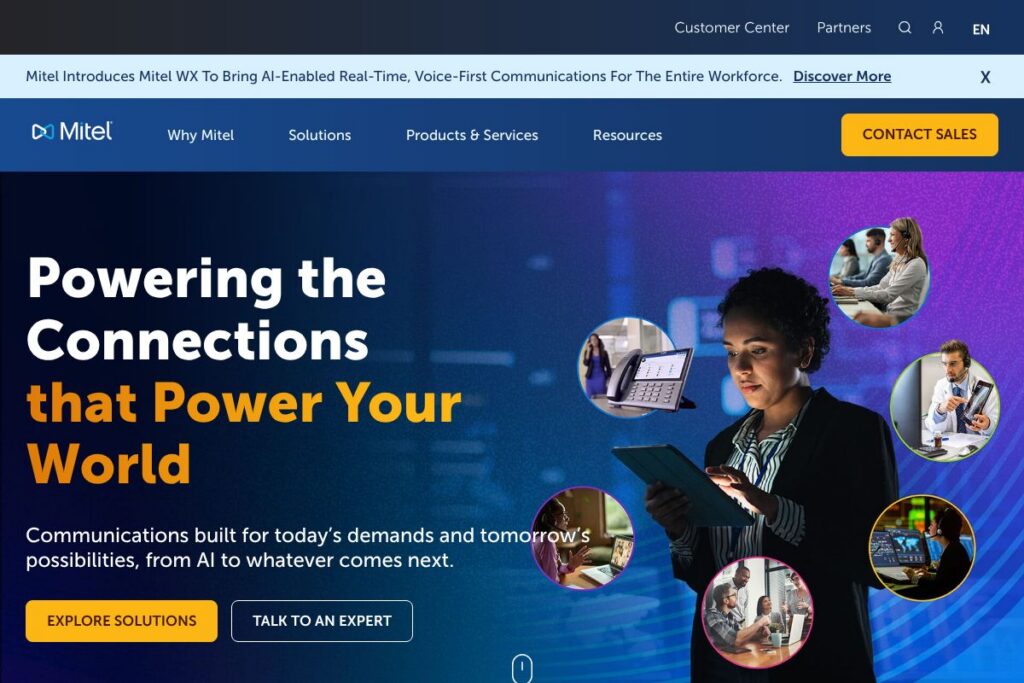
Mitel delivers unified communications and contact center solutions designed for hybrid deployments, supporting cloud, on-premises, and mixed models. The platform focuses on voice, collaboration, mobility, and contact center workflows while offering management and security features that suit regulated and distributed organizations. Explore Mitel’s portfolio on the Mitel solutions site.
Mitel competes with other enterprise communications providers while differentiating on hybrid flexibility and a long legacy in telephony. Compared with RingCentral, which is primarily cloud-native with published per-user plans, Mitel emphasizes customizable enterprise deployments and partner-led delivery. Compared with Cisco and Avaya, Mitel generally focuses more on mixed cloud and on-premises migration paths and on integrating legacy telephony investments into modern UC and contact center stacks.
All of this makes Mitel well suited to organizations that need flexible deployment options, strong voice and contact center capabilities, and a large partner ecosystem to handle integration and managed services.
How Mitel Works
Mitel combines a core communications platform with modular contact center and collaboration services, allowing organizations to pick cloud, on-premises, or hybrid architectures. Core components include session management for voice, SIP trunking, collaboration clients for desktop and mobile, and contact center routing and reporting engines that can run in different hosting models.
Typical implementations use Mitel to replace legacy PBX systems while preserving existing telephony where needed, or to provide a full cloud migration with integrations into directory services and CRMs. For contact center teams, Mitel routes interactions across voice, chat, and digital channels, logs interactions for analytics, and exposes administrative controls and reporting to supervisors through centralized management tools. See Mitel’s contact center offerings at the Mitel contact center page.
What does Mitel do?
Let’s talk Mitel’s Features. The platform centers on enterprise-grade voice, unified communications, and contact center capabilities with hybrid deployment options, security features, and integrations that enable broader enterprise workflows.
Unified Communications
Mitel provides voice, presence, messaging, and conferencing in a single suite that works across desktop and mobile clients. These capabilities let teams handle calls, schedule meetings, and exchange messages while preserving call quality and central administration across locations.
Contact Center
Mitel’s contact center tools include multichannel routing, workforce optimization, real-time dashboards, and reporting to support customer service operations. Supervisors can manage queues, monitor performance, and apply rules to route voice and digital interactions to the right agents.
Hybrid Deployment Options
Mitel supports cloud-first, on-premises, and hybrid deployments so organizations can migrate at their own pace and retain control over sensitive workloads. This flexibility is useful for organizations that must comply with data residency or have intermittent connectivity at remote sites.
Security and Compliance
The platform includes encryption for signaling and media, role-based access controls, and integrations for identity management to meet enterprise security and regulatory requirements. These features help organizations in healthcare, government, and financial services maintain compliance and secure communications.
Collaboration and Mobility
Mitel offers desktop and mobile clients that provide call handling, chat, presence, and meetings so remote and frontline workers can stay connected. Mobile and softphone features help field staff and remote employees remain reachable without relying on multiple point solutions.
AI and Analytics
Mitel adds analytics capabilities for contact center performance and operational insights, and it is integrating AI-assisted features for routing, transcription, and agent assist. Analytics feed into reporting and historical dashboards to help managers optimize staffing and identify trends.
Management and Administration
Centralized management tools let administrators provision users, configure routing and policies, and monitor system health across distributed deployments. Role-based administration and partner management tools make it easier to scale and hand off operational tasks to managed service providers.
Integrations and APIs
Mitel provides APIs and prebuilt connectors to CRMs, workforce management systems, and collaboration platforms to tie communications into business workflows. These integrations support use cases such as click-to-dial from customer records, screen pops for agents, and calendar-aware presence.
With these capabilities Mitel is strongest as a hybrid communications platform that supports voice continuity, enterprise contact centers, and compliance-aware deployments.
Mitel pricing
Mitel uses a custom enterprise pricing model tailored to deployment type, user counts, and optional contact center modules rather than fixed public per-user prices. Pricing typically depends on whether you choose cloud, on-premises, or hybrid hosting, required features, and any managed services or partner implementation work.
For detailed, organization-specific pricing and licensing options, view Mitel’s enterprise pricing details or contact their sales team through the Mitel contact page.
What is Mitel used for?
Mitel is commonly used to modernize enterprise voice systems, deploy unified communications across distributed teams, and run contact centers that handle voice and digital channels. Organizations use Mitel to consolidate telephony, provide consistent caller experiences, and add reporting and workforce management to customer service operations.
Industry-specific use cases include classroom safety and hybrid learning in education, secure patient communications in healthcare, regulated customer interactions in financial services, multi-site coordination in manufacturing, scalable guest communications in hospitality and cruise, and secure government communications. Mitel publishes industry guidance and solution examples on its industry solutions page.
Pros and Cons of Mitel
Pros
- Hybrid deployment options: Mitel supports cloud, on-premises, and mixed deployments, which helps organizations preserve existing telephony investments while modernizing at their own pace.
- Strong contact center capabilities: The platform offers multichannel routing, reporting, and workforce optimization tools that fit enterprise customer service operations.
- Enterprise security and compliance: Built-in encryption, role-based controls, and identity integrations make Mitel suitable for regulated industries.
- Broad partner network: Mitel’s global partner ecosystem supports local delivery, managed services, and vertical-specific integrations.
Cons
- Custom pricing model: Because pricing is typically enterprise and implementation based, small organizations may find it harder to compare costs against per-user cloud-first competitors.
- Implementation complexity: Hybrid and on-premises options can introduce migration and operational complexity that requires skilled partners or internal resources.
- Less transparent public pricing: The absence of published per-user plans means procurement often requires direct engagement with sales or channel partners.
Does Mitel Offer a Free Trial?
Mitel offers custom trials and demo engagements rather than a public free plan. Organizations can request a tailored trial, proof of concept, or demo via the Mitel contact page to evaluate specific features and deployment models before committing to licensing.
Mitel API and Integrations
Mitel provides developer APIs and prebuilt connectors to integrate communications with CRMs, workforce management, and collaboration platforms. The Mitel developer resources describe available APIs for call control, presence, and contact center telemetry.
Key integrations include connectors for Microsoft Teams, CRM platforms such as Salesforce, and directory services for single sign-on and user provisioning. These integrations let organizations embed communications into customer workflows, enable click-to-dial from records, and synchronize presence with calendars.
10 Mitel alternatives
Paid alternatives to Mitel
- RingCentral — Cloud-native UCaaS and contact center platform with published per-user plans and strong integrations for small to mid-market teams.
- Cisco — Broad enterprise communications portfolio including Cisco Unified Communications Manager and Webex calling focused on large enterprise networking environments.
- Avaya — Longstanding telephony and contact center vendor offering on-premises and cloud options with deep contact center features.
- 8×8 — Cloud-first communications and contact center suite that emphasizes subscription pricing and analytics for contact centers.
- Zoom Phone — Integrated calling within Zoom’s meeting platform, attractive for organizations already standardized on Zoom collaboration.
- Microsoft Teams — As a collaboration and calling platform, Teams combines chat, meetings, and PSTN calling through Microsoft or partner carriers.
- Genesys — Enterprise contact center platform focused on omnichannel routing and AI-driven customer experience for large contact centers.
Open source alternatives to Mitel
- Asterisk — Open source telephony engine for building PBX and contact center functionalities with high customizability and self-hosting control.
- FreeSWITCH — Scalable telephony platform for voice, video, and messaging that supports custom communication solutions and self-hosted contact centers.
- Kamailio — High-performance SIP server used for routing and load balancing in large-scale VoIP deployments and service provider environments.
- OpenSIPS — SIP routing platform suitable for building carrier-grade voice, conferencing, and SIP trunking solutions.
Frequently asked questions about Mitel
What is Mitel used for?
Mitel is used for unified communications and contact center operations across cloud, on-premises, and hybrid deployments. Organizations use it to modernize telephony, run multichannel contact centers, and provide unified collaboration tools.
Does Mitel integrate with Microsoft Teams?
Yes, Mitel offers integrations with Microsoft Teams. These integrations allow calling and presence synchronization between Mitel systems and Teams clients to support hybrid communication workflows.
Can Mitel support regulated industries like healthcare and government?
Yes, Mitel includes security and compliance features suitable for regulated sectors. Encryption, role-based controls, and deployment flexibility help meet privacy and regulatory requirements.
How does Mitel sell its products and pricing?
Mitel sells primarily through a partner and enterprise sales model with custom pricing. Pricing depends on deployment model, required modules, and any managed services or implementation needs.
Does Mitel provide APIs for developers?
Yes, Mitel provides developer APIs and integration resources. The developer portal contains documentation for call control, contact center telemetry, and connectors to CRM and identity systems.
Final verdict: Mitel
Mitel is a mature choice for organizations that need flexible deployment options and robust voice and contact center capabilities. Its hybrid-first approach and strong partner network make it suitable for enterprises that must balance legacy telephony, regulatory needs, and a staged migration to the cloud.
Compared with RingCentral, which publishes transparent per-user cloud pricing and targets cloud-native deployments, Mitel focuses on customizable enterprise engagements and hybrid migration paths. If your organization needs tight control over deployment models, on-premises continuity, or extensive partner-managed services, Mitel is a strong option; if you prefer simple, self-service cloud pricing, a cloud-native vendor like RingCentral may be easier to evaluate.