Surveypal in a Nutshell
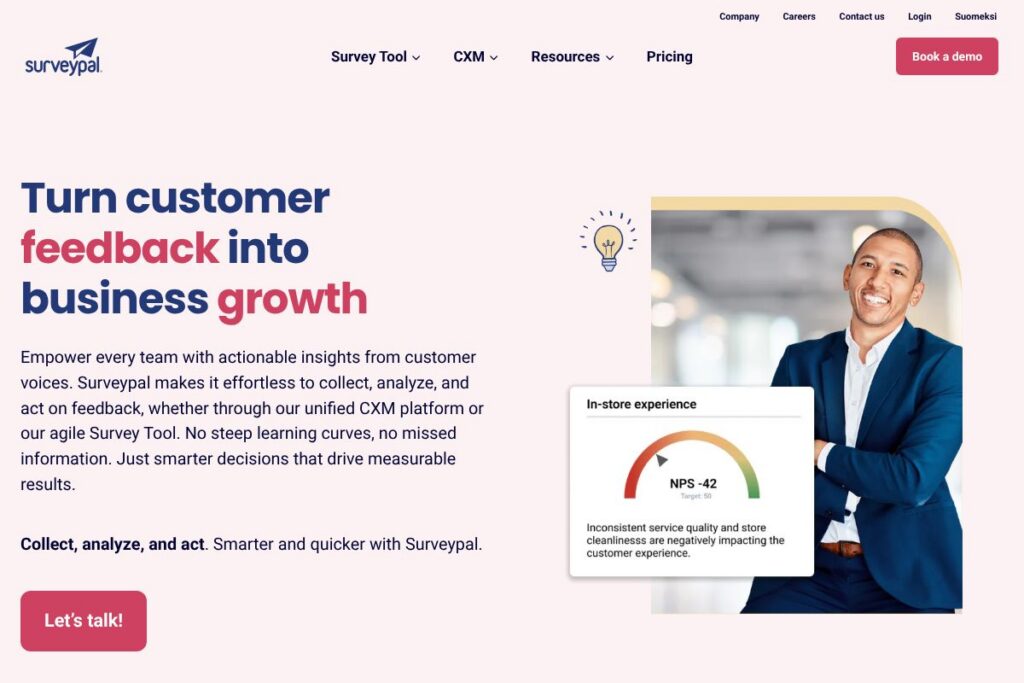
Surveypal is a customer feedback and CX management platform designed to bring all feedback sources into a single view and help teams act on insights quickly. The platform combines survey authoring, multichannel feedback collection, text analytics, and workflow automation so teams can move from data to decisions without large integration projects.
Compared with Qualtrics, which targets broad enterprise research and deep experience management use cases, Surveypal focuses on fast setup and operational feedback workflows that fit both mid-market and enterprise customers. Versus Medallia, Surveypal places more emphasis on lightweight survey tooling and modular connectors for support systems. Compared with Momentive (SurveyMonkey), Surveypal is positioned more as a CXM product rather than a general-purpose survey tool.
All of this makes Surveypal especially useful for organizations that need a single place to capture direct and inferred feedback, run ongoing CX programs, and route actions to product, support, and operations teams. It targets CX teams who want a balance of analytics and operational controls with lower implementation overhead than some enterprise-only platforms.
How Surveypal Works
Surveypal collects feedback from multiple channels including in-product surveys, transactional surveys, support platforms, and indirect sources such as chat transcripts. Incoming data is ingested into a unified CXM workspace where it is normalized, tagged, and enriched with automated text analysis and sentiment scores.
Teams configure dashboards, alerts, and workflows to prioritize issues and assign follow-up actions. For example, a support team can route low CSAT items into a ticket queue in Zendesk while product managers receive aggregated verbatims grouped by feature requests. Surveypal’s connector framework reduces the need for custom ETL, making it practical to onboard sources quickly using available integration connectors like Zendesk and CRMs.
Surveypal features
Surveypal combines feedback capture, analytics, and operational workflows into a single platform aimed at turning voice-of-customer data into outcomes. Core capabilities include survey creation, multichannel collection, natural language processing, closed-loop automation, and an analytics workspace that surfaces trends and drivers of satisfaction.
Let’s talk Surveypal’s Features
Survey authoring and templates
Create surveys using a visual editor and prebuilt templates for NPS, CSAT, CES, and customer interviews. The editor supports conditional logic, multilingual surveys, and lightweight A/B testing so teams can iterate on question design and route respondents based on answers.
Multichannel feedback collection
Capture feedback across web, mobile, email, in-app, and support systems so you can link responses to customer records. Having a single capture layer helps reduce sample bias and makes it easier to compare signals across touchpoints.
Text analytics and sentiment
Automated text analysis extracts topics, themes, and sentiment from open-text responses and support transcripts. This reduces manual tagging overhead and highlights common drivers behind scores so product and CX teams can prioritize work on the issues that matter most.
CXM dashboard and reporting
Dashboards surface key metrics such as NPS, CSAT, and trend-based KPIs with the ability to slice by segment, product, or geography. Reporting includes anomaly detection and time-series comparisons to monitor program health without building custom BI views.
Workflow automation and closed-loop follow-up
Define rules to route low scores or urgent verbatims to the right team, trigger surveys after specific events, and automate follow-ups. Closed-loop workflows help reduce churn risk by ensuring issues are resolved and logged for follow-up analysis.
Integrations and data centralization
Connectors and APIs bring survey responses and ticketing data together for unified reporting and enrichment. Common integrations include support platforms and CRMs so you can correlate feedback with customer metadata and historical tickets.
Security and data governance
Cloud-hosted architecture includes role-based access, encryption in transit and at rest, and configurable data retention policies. These controls help compliance teams manage privacy requirements while allowing CX teams to use data confidently.
Surveypal’s biggest benefit is its focus on operationalizing feedback: it does not just measure satisfaction but provides the tooling to act, escalate, and track the impact of those actions across teams.
Surveypal pricing
Surveypal uses an enterprise SaaS pricing model with flexible plans tailored to organization size, data volume, and integration needs. Pricing is typically customized for each customer to reflect numbers of users, feedback volume, and required support or compliance features.
Surveypal does not publish standard plan rates; for a quote and plan options, view Surveypal’s contact and demo pages to request commercial terms and deployment options. The team can provide tiered packages for small teams through full enterprise deployments depending on your requirements.
Surveypal Use Cases
Customer success and support teams use Surveypal to collect post-interaction CSAT, tag verbatims automatically, and escalate high-priority issues into their ticketing systems. That reduces the time between identifying a problem and resolving it, improving retention and first-contact resolution metrics.
Product and UX teams use Surveypal to run in-app surveys, gather feature requests, and analyze open feedback for prioritization. Marketing and strategy teams use aggregated sentiment and trend reports to inform roadmaps and messaging.
Pros and Cons of Surveypal
Pros
- Unified feedback repository: Combines surveys, support transcripts, and inferred signals so teams can analyze customer voice in one place, reducing fragmentation across tools.
- Operational automation: Workflow rules and integrations let teams close the loop with customers and track the impact of follow-up actions on satisfaction metrics.
- Text analytics built in: Automated topic extraction and sentiment help teams surface trends without heavy manual tagging, accelerating insight discovery.
- Cloud-based deployment: Hosted SaaS model simplifies rollouts and updates, making it easier for IT and security teams to manage access and compliance.
Cons
- Custom pricing model: Enterprise-oriented pricing requires contacting sales for quotes, which can slow initial evaluation for smaller teams seeking transparent list prices.
- Feature depth varies vs large incumbents: While strong on operational feedback, some advanced research and experience analytics features found in larger vendors may be less comprehensive.
- Onboarding coordination: Consolidating many feedback sources still requires planning and cross-team coordination to ensure connectors and workflows are configured correctly.
Does Surveypal Offer a Free Trial?
Surveypal offers demo and trial options to evaluate the platform. Prospective customers can request a guided demo and trial access to test survey creation, feedback ingestion, and dashboards; contact the team to arrange a trial environment or product walkthrough.
Surveypal API and Integrations
Surveypal provides integration connectors for common systems and a developer API for custom workflows. The integration catalog includes connectors for ticketing and CRM systems, and webhooks for real-time event forwarding; see the Surveypal integration connectors for details.
Developer teams can extend functionality using the API for data ingestion, export, and triggering surveys from application events; refer to the API documentation for available endpoints and authentication methods to plan integrations.
10 Surveypal alternatives
Paid alternatives to Surveypal
- Qualtrics – Enterprise-grade experience management with broad survey capabilities and deep analytics for research and CX programs.
- Medallia – Focused on real-time experience management at scale, often used by large enterprises for operationalizing feedback across channels.
- Momentive (SurveyMonkey) – General-purpose survey platform with a range of templates and enterprise features for feedback collection and analysis.
- Typeform – Conversational survey design and form experience with easy-to-use templates and integrative workflows for customer feedback.
- Alchemer – Advanced survey features with strong data routing and conditional logic suited for enterprise feedback programs.
- Hotjar – Behavioral analytics and feedback widgets for web product teams, combining heatmaps with user feedback tools.
- AskNicely – NPS-focused platform with automation and workflow features for customer success teams.
Open source alternatives to Surveypal
- LimeSurvey – Self-hosted survey platform for organizations that need full control over data and customization of survey logic.
- Fider – Open-source product feedback board for collecting and prioritizing user suggestions and votes.
- SurveyJS – An open-source survey library and framework for embedding survey experiences into custom applications and dashboards.
Frequently asked questions about Surveypal
What is Surveypal used for?
Surveypal is used to collect and manage customer feedback across multiple channels. Teams centralize surveys, support transcripts, and inferred signals to analyze sentiment, prioritize issues, and run closed-loop workflows.
Does Surveypal integrate with Zendesk?
Yes, Surveypal integrates with Zendesk. The integration can import ticket data and route response follow-ups into the Zendesk workflow for agent handling.
Can Surveypal analyze open-text feedback automatically?
Yes, Surveypal provides automated text analytics and sentiment scoring. The platform extracts themes and trends from verbatim responses to reduce manual tagging and speed up insight generation.
How does Surveypal handle data security?
Surveypal uses cloud-hosted architecture with role-based access and encryption. The platform includes controls for data retention and governance to support privacy and compliance requirements.
Is Surveypal suitable for small businesses?
Surveypal can be suitable for small and mid-market teams looking for an operational CX tool. The platform scales from simple surveys to enterprise-level feedback programs, though commercial terms are typically discussed with sales.
Final Verdict: Surveypal
Surveypal excels at turning dispersed customer signals into operational workflows that teams can act on. Its strengths are rapid onboarding, multichannel capture, built-in text analytics, and workflow automation that help support, product, and CX teams reduce friction in closing the feedback loop.
Compared with Qualtrics, which often targets large enterprise research programs with broad analytics and higher licensing complexity, Surveypal emphasizes faster deployment and practical integrations for teams that need to move from insight to action. For organizations that prioritize operational CX and want an integrated feedback-to-workflow platform without a lengthy implementation, Surveypal is a focused and practical option.