What is Ada
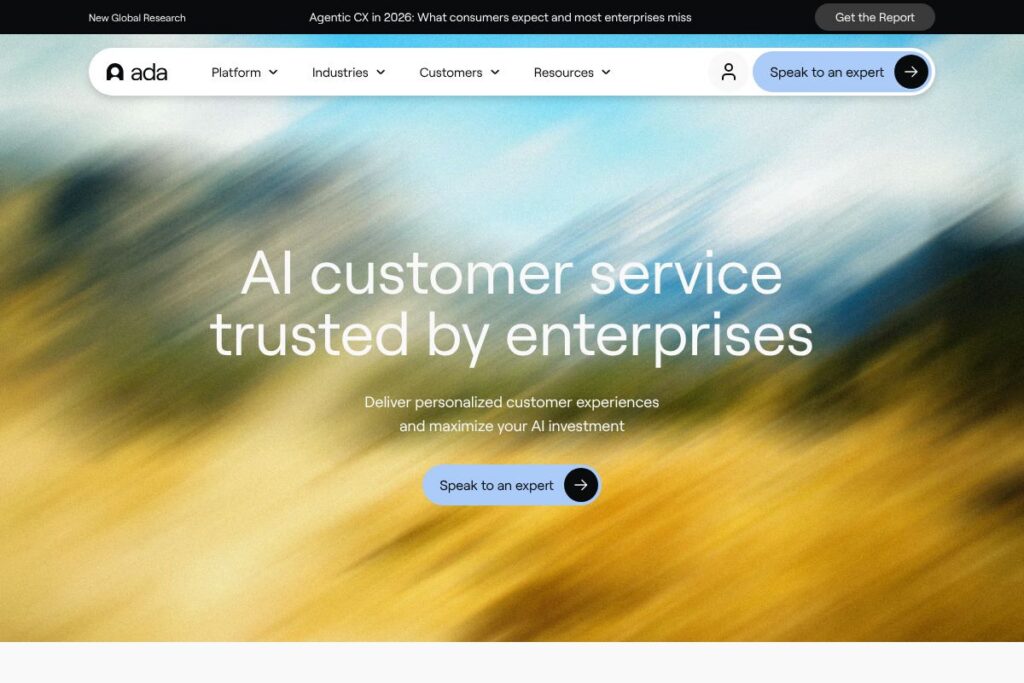
Ada is an AI customer service platform that uses conversational agents to resolve customer inquiries across chat, messaging, and other channels. The platform focuses on autonomous resolution, routing complex issues to human agents, and preserving conversation continuity and identity across channels.
Ada is positioned for enterprise customers who require compliance, multi-language support, and integration with existing CRMs and contact centers. Compared with Zendesk, which centers on ticketing and agent workflows, Ada prioritizes autonomous agent resolution and conversational automation. Against Intercom, Ada emphasizes enterprise-grade security and LLM orchestration rather than SMB conversational tooling. Compared with open source frameworks like Rasa, Ada delivers a managed platform with prebuilt integrations, analytics, and compliance controls.
All of this makes Ada particularly well suited to large customer support organizations that want to reduce cost per contact, improve CSAT, and deploy AI-driven agents across channels and languages while keeping enterprise security and governance in place.
How Ada Works
Ada runs prebuilt and custom conversational flows that combine retrieval, rule-based logic, and large language models to understand customer intent and either resolve issues autonomously or escalate to humans. The platform maintains customer context and identity across sessions, so handoffs to human agents include complete context and reduce handle time.
Teams typically implement Ada by connecting it to their knowledge base and backend systems via APIs and connectors, training it on common intents, and configuring escalation rules for complex cases. Monitoring tools and A/B testing in the platform let teams iteratively improve agent performance and measure automated resolution rates against targets.
Ada features
Ada’s feature set centers on autonomous conversational agents, enterprise-grade analytics, LLM orchestration, and integrations that keep customer identity intact across channels. Recent platform additions emphasize multi-LLM orchestration, expanded compliance controls, and tools for continuous performance optimization.
Conversational AI Agents
Ada delivers AI agents that handle natural language conversations and map customer intents to actions or answers. These agents are designed to resolve common inquiries without human intervention, reducing volume handled by contact centers and shortening customer wait times.
Multi-channel Deployment
The platform supports deployment across web chat, in-app messaging, SMS, social channels, and more, preserving conversation history and context. This helps teams provide consistent experiences whether customers switch channels or return later.
LLM Orchestration and Safety Controls
Ada can route queries across multiple language models and retrieval systems while applying safety filters, hallucination mitigations, and alignment checks. This orchestration helps balance accuracy, cost, and safety for enterprise use.
Integrations and Connectors
Prebuilt integrations and open APIs let Ada connect to CRMs, ticketing systems, payment platforms, and knowledge bases. That connectivity enables actions like order lookups, refunds, and account updates without exposing sensitive data.
Analytics and Continuous Optimization
Built-in analytics track automated resolution rates, CSAT, fallbacks, and escalation patterns so teams can iterate on conversational flows and measure ROI. Experimentation tools support testing different prompts and logic to improve agent accuracy.
Compliance and Security
Ada includes features designed for enterprise compliance, such as data handling controls, encryption, and controls for regulatory regimes including GDPR and HIPAA. These features support deploying conversational AI in regulated industries.
With these capabilities, Ada aims to reduce live agent load while preserving experience continuity and compliance, letting support organizations shift their human agents toward higher-value work.
Ada pricing
Ada follows an enterprise pricing model with custom plans that scale by deployment size, channels, and required compliance features. For tailored cost estimates and licensing options, check Ada’s website or contact their sales team for current pricing and packaging information.
What is Ada Used For?
Ada is commonly used to automate first-line customer support, resolve high-volume routine inquiries, and surface contextual information for human agents during escalations. Teams deploy Ada to reduce handle times, shorten wait times for customers, and maintain consistent answers across channels.
Ada is also used in regulated industries such as financial services, healthcare, and travel where data protection, auditability, and multi-language support are required. Enterprise CX teams use the platform to scale service coverage without proportionally increasing headcount.
Pros and Cons of Ada
Pros
- High automated resolution rates: Ada is built to autonomously resolve a large share of customer interactions, which reduces ticket volume and operating cost. The platform’s LLM orchestration and retrieval capabilities increase first-contact resolution for common issues.
- Enterprise-grade security and compliance: Ada offers controls for data protection, encryption, and regulatory compliance to meet HIPAA and GDPR requirements, which is important for regulated sectors.
- Seamless integrations and context preservation: Ada integrates with common CRMs and contact center tooling so customer context follows the interaction into human escalations, cutting down on repeat questions and handle time.
Cons
- Custom deployment required for complex flows: Enterprises often need professional services or dedicated implementation to model complex business logic and integrate backend systems, which can extend time to value.
- Enterprise focus may be heavier than SMB needs: Organizations with simple chat requirements or limited budgets may find Ada’s feature set and governance model more complex than necessary for smaller use cases.
Does Ada Offer a Free Trial?
Ada offers demos and trial options through its sales process. Prospective customers can request a tailored demo or pilot to evaluate autonomous agent performance, multi-channel behavior, and integration workflows; contact options are available on Ada’s website.
Ada API and Integrations
Ada provides developer APIs and SDKs for integrating with CRMs, ticketing systems, and backend services; the developer documentation outlines endpoints for actions, user context, and webhook-based events. These APIs let teams automate lookups, trigger account changes, and include customer metadata in conversations.
Key prebuilt integrations include common platforms used by support and product teams, enabling connectors for systems such as Salesforce, Zendesk, and messaging channels. For enterprise orchestration and custom workflows, Ada supports webhooks and middleware patterns to fit existing architectures; see Ada’s integrations information.
10 Ada alternatives
Paid alternatives to Ada
- Zendesk — Ticketing-first customer support platform with chat, help center, and agent tools suited to mid-market and enterprise teams.
- Intercom — Conversational customer platform focused on messaging, product-led growth workflows, and in-app support for product teams.
- Salesforce Service Cloud — Enterprise service platform tightly integrated with Salesforce CRM and case management for complex enterprise workflows.
- Freshdesk — Cloud-based support suite with omnichannel ticketing and automation for small to medium teams.
- LivePerson — Conversational AI and messaging platform that emphasizes agent assist and AI routing for large-scale customer engagement.
- Genesys Cloud CX — Contact center solution with routing, workforce engagement, and AI capabilities for voice and digital channels.
- Kustomer — CRM-centric service platform that unifies customer data and automates conversational workflows for support teams.
Open source alternatives to Ada
- Rasa — Open source conversational AI framework for building custom assistants with full control over NLU and dialogue management.
- Botpress — Developer-oriented open source chatbot platform with modular components for building conversational experiences.
- Chatwoot — Open source customer engagement platform that provides messaging, inboxes, and basic automation for small teams.
- Rocket.Chat — Open source team chat and customer messaging platform that can be extended for conversational support use cases.
- OpenDialog — Open source conversational application platform for designing complex dialog flows and multimodal experiences.
Frequently asked questions about Ada
What is Ada used for?
Ada is used to automate customer support with conversational AI agents. Organizations deploy Ada to handle routine inquiries, reduce ticket volume, and route complex issues to human agents with full context.
Does Ada integrate with Salesforce and Zendesk?
Yes, Ada integrates with common CRMs and ticketing systems including Salesforce and Zendesk. Integrations provide contextual data and enable actions like lookups and ticket creation without leaving the conversation.
Can Ada handle multiple languages?
Ada supports multi-language deployments. The platform includes localization tools and language models to provide consistent experiences across regions.
Is Ada compliant with enterprise security standards?
Ada offers enterprise-grade security and compliance controls. The platform includes features and processes to support GDPR, HIPAA, SOC2, and other regulatory requirements.
Does Ada provide API access for developers?
Yes, Ada provides developer APIs and SDKs. The developer documentation explains endpoints for managing conversations, user context, and integrations.
Final Verdict: Ada
Ada excels at deploying autonomous conversational agents for enterprise customer service where compliance, multi-channel continuity, and integration with back-end systems are priorities. The platform’s focus on LLM orchestration, safety controls, and analytics makes it a solid choice for organizations that need high automated resolution rates and governance for sensitive data.
Compared with Intercom, which targets product and growth teams with transparent SMB pricing and conversational tooling, Ada is geared toward enterprise deployments and custom pricing and support. Organizations that need strict compliance, multi-LLM orchestration, and deep backend integrations will likely prefer Ada, while smaller teams seeking out-of-the-box conversational products may find alternatives with published plans more accessible.
For pricing, demos, and technical details about enterprise deployments and compliance, review Ada’s platform information or contact their sales team for a tailored estimate.