Hellonext
Feedback management and public roadmap platform for SaaS and product teams. Hellonext provides customer-facing feedback boards, roadmap pages, changelogs, and integrations that help product managers centralize requests, prioritize work, and keep customers informed.
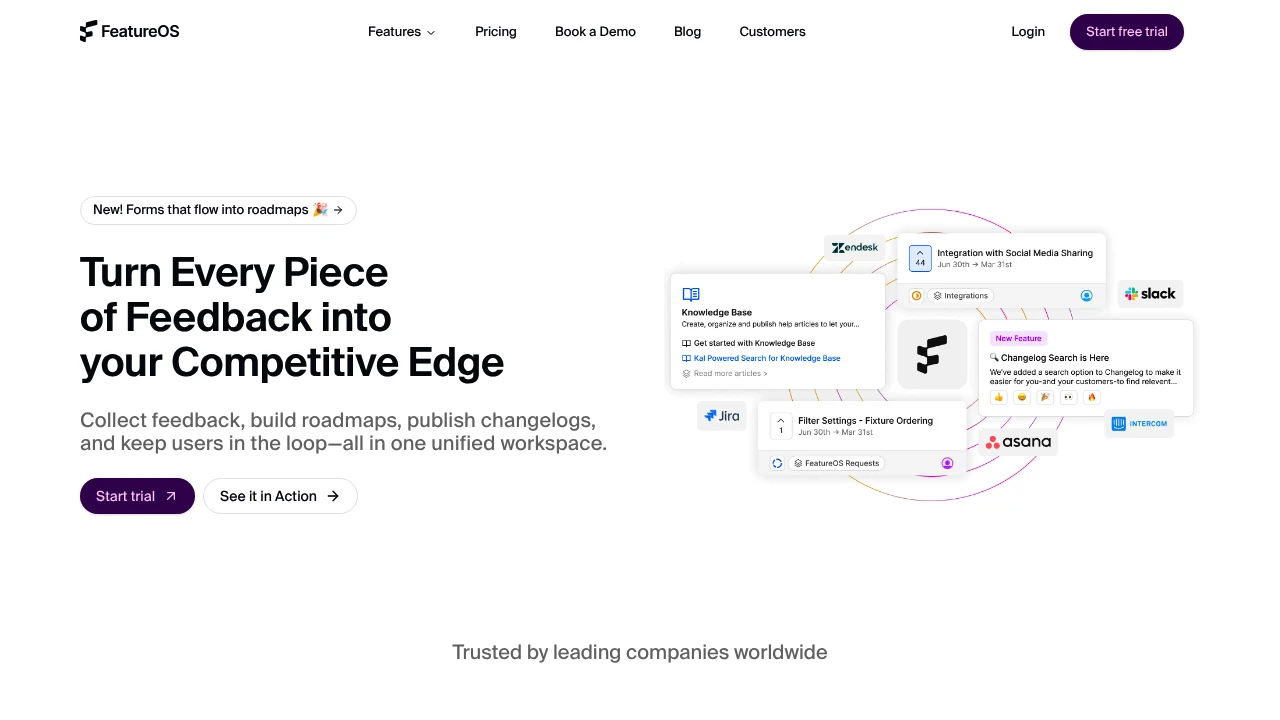
What is hellonext.co
Hellonext.co is a hosted feedback and roadmap platform that helps product teams gather user suggestions, prioritize feature requests, publish a public roadmap, and announce releases via a changelog. The product is aimed at SaaS companies, startups, customer success teams, and product managers who need a single public-facing place to collect customer ideas and convert them into actionable work items.
The service offers a lightweight embeddable feedback board that can be added to a website or product, a customizable public roadmap to show planned and in-progress features, and a changelog to communicate completed work. Hellonext.co focuses on user-driven prioritization: visitors can submit ideas, vote on existing requests, and discuss items with comments. That crowd-sourced input helps teams identify trends and justify roadmap decisions.
Hellonext.co also includes administrative tools for triaging feedback, tagging and filtering requests, and converting popular suggestions into private tasks or tickets in your product development workflow. The platform is built to be simple for customers to use while providing product teams with enough metadata (votes, comments, tags, status) to make prioritization decisions.
Hellonext.co features
What does hellonext.co do?
Hellonext.co collects customer feedback through public and private boards, aggregates votes and comments, and surfaces the highest-priority ideas for product teams. It publishes public roadmaps so customers can see planned work and uses changelogs to announce releases and improvements. The platform helps reduce inbound support noise by giving customers a structured place to submit and track requests.
Key feature areas include: submission forms and widgets for feedback capture, voting and comment systems for community-driven prioritization, status-driven roadmap pages (e.g., planned, in progress, launched), and changelog pages where releases can be published with release notes. Admins can tag requests, apply custom statuses, and merge duplicate items to keep the backlog manageable.
Additional features include basic user management and moderation controls, embed scripts and direct links for sharing boards, customizable branding for public pages, and email notifications for activity on tracked items. The interface is generally optimized for straightforward adoption by product and support teams and for easy use by end customers.
The platform also emphasizes analytics around feedback — vote counts, comment volumes, and activity timelines — which help teams spot high-impact requests and measure engagement with roadmaps and changelogs.
Hellonext.co pricing
Hellonext.co offers these pricing plans:
- Free Plan: $0/month with limitations on features and data retention
- Starter: $29/month (monthly billing) with increased seats, branding options, and more boards
- Professional: $79/month (monthly billing) with advanced moderation, integrations, and reporting
- Enterprise: Contact for pricing with SSO, dedicated support, and custom contracts
The tiers above represent typical offerings for feedback and roadmap platforms: a free tier for basic boards, a mid-level plan for growing teams, a professional plan for full-featured use, and an enterprise option for organizations with advanced security and compliance requirements. Check Hellonext's current pricing tiers (https://hellonext.co/pricing) for the latest rates and enterprise options.
How much is hellonext.co per month
Hellonext.co starts at $0/month for the Free Plan. For paid use the apparent entry paid tier commonly listed starts at $29/month for a single-site Starter subscription when billed monthly.
How much is hellonext.co per year
Hellonext.co costs roughly $288/year for the Starter plan when billed annually at an effective $24/month rate (example annual discount applied). Professional annual renewals commonly appear as roughly $828/year for a plan equivalent to $69/month when billed annually. Enterprise pricing is provided on request.
How much is hellonext.co in general
Hellonext.co pricing ranges from $0 (free) to Enterprise-level custom pricing. The lower end provides a basic board with voting and limited branding options; mid-tier plans add customization, more seats or boards, analytics, and integrations; enterprise plans add single sign-on (SSO), higher SLAs, and dedicated support.
Use the public pricing page at Hellonext to compare current plan limits and billing frequency as vendors occasionally adjust tiers and promotional pricing: view Hellonext's current pricing tiers (https://hellonext.co/pricing).
What is hellonext.co used for
Hellonext.co is used to collect and manage customer feedback publicly or privately, to run a visible product roadmap that customers can follow, and to publish changelogs announcing product updates. Teams use the tool to centralize inbound feature requests instead of scattering them across email, support tickets, and chat.
Common use cases include: validating new product ideas by measuring votes and comments, prioritizing features backed by visible customer interest, reducing support ticket volume by directing users to a feedback board, and improving transparency by publishing roadmap milestones and release notes.
Product, support, and growth teams use Hellonext.co to create a continuous feedback loop: capture suggestions, prioritize using vote counts and internal tags, and communicate status updates publicly so customers know whether a request is planned or shipped. The platform also helps sales and account teams show prospective customers that their needs are noticed and tracked.
The platform is particularly useful for early-stage SaaS companies and small to mid-market product teams that want a simple, customer-facing feedback workflow without building and maintaining a bespoke solution.
Pros and cons of hellonext.co
Hellonext.co provides a compact, user-friendly interface for feedback collection, voting, and roadmapping. Pros include the simplicity of setup, embeddable widgets for product pages, and a public roadmap and changelog that improve transparency with customers. The voting model helps focus teams on features with clear customer interest.
Pros:
- Rapid deployment with embeddable feedback widgets and pre-built public pages
- Community-driven prioritization via voting and comments
- Built-in changelog and roadmap pages to centralize product communication
- Integrations and webhooks for connecting to support or development tools
Cons:
- Feature set targets feedback and communication rather than full product lifecycle management — teams needing heavy project management may require additional tools
- Analytics are typically aggregate-level; advanced segmenting and deep behavioral analytics are limited compared with full product analytics suites
- Enterprise features such as SSO and SLAs are gated behind custom contracts and may carry significant additional cost
In practice, Hellonext.co is best when used alongside issue trackers and product management platforms. It is optimized for visibility and user engagement, not as a replacement for detailed internal backlog management.
Hellonext.co free trial
Hellonext.co commonly offers a Free Plan that allows teams to set up a basic feedback board with voting and minimal customization. That free tier is designed for evaluation, community testing, and small projects. It typically limits features such as the number of boards, seats, private boards, or historical data retention.
Paid tiers usually include trial periods or a money-back window for new customers; specifics vary over time and by promotion. Because the Free Plan provides a baseline of functionality, many teams start there to validate the feedback workflow before upgrading to unlock branding control, integrations, and advanced moderation.
To verify the current free trial mechanics and any limited-time promotions, consult Hellonext's official pricing information and terms: Hellonext's current pricing tiers (https://hellonext.co/pricing).
Is hellonext.co free
Yes, Hellonext.co offers a Free Plan that provides a basic feedback board and the ability to collect votes and comments from users. The free tier is intended for personal projects or very small teams and typically includes limits on branding, integrations, and number of contributors.
Hellonext.co API
Hellonext.co provides API access and webhook capabilities that allow product teams to automate interactions between the feedback board and internal systems. Common API functionality includes creating and updating feedback items, retrieving lists of votes and comments, and subscribing to webhooks for events such as new suggestions or status changes.
Developers use the Hellonext API to synchronize feedback items with issue trackers (for example creating GitHub/GitLab issues from popular requests), to export voting and comment data into analytics tools, or to automate customer notifications once a feature moves to a new status. The combination of REST-style API endpoints and webhook events enables near real-time integrations into existing product workflows.
For specific API endpoints, rate limits, authentication methods, and code examples, consult Hellonext's developer documentation: Hellonext API documentation (https://hellonext.co/api). If enterprise-grade API or higher rate limits are required, teams should review the Enterprise offering or contact Hellonext support for contract-level arrangements.
10 Hellonext.co alternatives
- Canny — Product feedback, public roadmaps, and changelogs with strong enterprise integrations and SSO
- Productboard — Prioritization and product management platform that consolidates feedback from multiple channels
- UserVoice — Classic feedback and roadmap tool with advanced enterprise features and segmentation
- Notion — Flexible workspace where teams can build public pages and lightweight feedback workflows
- Intercom — Customer messaging platform that includes in-product feedback collection and product tours
- Pendo — Product analytics with in-app feedback and roadmap capabilities for product-led growth teams
- FeatureUpvote — Simple voting board focused on collecting and ranking user ideas
- Trello — Flexible kanban boards often used as a lightweight internal backlog in combination with feedback boards
- Jira — Full-featured issue and project tracker used to convert validated feedback into development work
- Upvoty — Feedback board with voting and roadmap pages aimed at small businesses
Paid alternatives to Hellonext.co
- Canny — Paid plans include more advanced moderation, SSO, and private boards; aimed at fast-growing SaaS teams
- Productboard — Prioritization workspace that connects product strategy with user insights; higher price but deeper roadmap analytics
- UserVoice — Enterprise-focused feedback and voice-of-customer features with segmentation and advanced workflows
- Pendo — Combines analytics, guides and feedback; higher-cost option for teams needing product analytics and in-app guidance
- Intercom — Focuses on customer messaging but offers paid tools for feedback capture embedded in conversations
These paid tools typically offer stronger enterprise controls, richer integration sets, and more advanced analytics than a basic feedback board.
Open source alternatives to Hellonext.co
- Fider — Open-source feedback platform you can self-host; supports voting, comments, and public boards
- PostHog (feedback modules) — While PostHog is a product analytics platform, community plugins and modules can be used to capture feedback in self-hosted deployments
- FeatureHub — An open-source feature management platform that can be extended with feedback capture in some deployments
Open source options require hosting and maintenance but provide full control over data and customization, which appeals to teams with strict compliance requirements or the engineering bandwidth to self-host.
Frequently asked questions about Hellonext.co
What is Hellonext.co used for?
Hellonext.co is used for collecting customer feedback, running public roadmaps, and publishing changelogs. Teams use it to centralize incoming feature requests, let customers vote and comment, and communicate progress on product work. The platform reduces support noise and provides product teams with quantified user interest for prioritization.
Does Hellonext.co integrate with Jira or GitHub?
Yes, Hellonext.co supports integrations and webhooks for issue trackers like Jira and GitHub. You can automate creation of issues from popular requests and synchronize status updates so product development work aligns with public roadmap statuses.
How much does Hellonext.co cost per month?
Hellonext.co starts at $0/month for the Free Plan and paid plans typically begin at around $29/month for the Starter tier when billed monthly. Higher tiers add integrations, custom branding, and admin controls.
Is there a free version of Hellonext.co?
Yes, Hellonext.co offers a Free Plan that includes basic feedback boards with voting and commenting. The free tier usually limits branding options, integrations, and the number of contributors or boards.
Can Hellonext.co be used for private internal feedback?
Yes, Hellonext.co supports private boards and restricted access configurations so internal teams can collect feedback from employees or specific customer segments without publishing items publicly.
Does Hellonext.co provide an API?
Yes, Hellonext.co provides an API and webhook support that allow teams to programmatically create and update feedback items, read votes and comments, and subscribe to events for automation. The API enables integration with CRM, analytics, and issue trackers.
Can I white-label Hellonext.co public pages?
Yes, paid plans typically include customization and branding options so you can align the look of feedback boards, roadmaps, and changelogs with your product’s visual identity. Free plans often limit branding control.
How secure is Hellonext.co for business use?
Hellonext.co offers standard security practices suitable for SaaS product teams, including encrypted transport (HTTPS) and account controls; enterprise contracts can include stronger controls such as SSO and data residency discussions. For specifics on compliance ask Hellonext for documentation or review their security pages.
Can customers vote on feedback anonymously?
Yes, Hellonext.co supports both identified and anonymous voting depending on configuration. Boards can require sign-in to vote or allow anonymous votes, depending on whether the team wants to encourage frictionless participation or track voter identity.
How do I export feedback and votes from Hellonext.co?
Hellonext.co supports data export and API access to retrieve feedback items, votes, and comments. Teams commonly export data for offline analysis, reporting, or to import into other product tools; the API and CSV export options make this straightforward.
Hellonext.co careers
Hellonext.co, like many SaaS providers, hires for roles spanning product, engineering, customer success, and marketing. Companies in the feedback-and-roadmap space typically look for engineers familiar with web stacks, product managers with experience running B2B SaaS products, and customer success staff who can onboard customers and support community management.
Career pages usually list remote-friendly roles due to the product’s appeal to distributed teams. Candidates interested in roles at Hellonext.co should review the company’s careers or jobs page for up-to-date openings and the specifics of each role.
If you are interested in working at a company that builds product tooling, highlight experience with large-scale web applications, REST APIs, UX for feedback systems, or experience integrating with developer tooling and CRMs.
Hellonext.co affiliate
Hellonext.co may offer partner or affiliate programs aimed at agencies and consultants who install and manage feedback boards for multiple clients. Affiliate arrangements can include referral credits, discounted seats, or reseller agreements intended for agencies managing multiple product instances.
Agencies that recommend Hellonext.co to clients typically look for predictable billing, white-label options, and multi-site management features. If you plan to refer customers, contact Hellonext.co’s sales or partnerships team for program details and any required contractual terms.
Where to find Hellonext.co reviews
User reviews for Hellonext.co are commonly found on software directories and SaaS review platforms. Search for user feedback and case studies on review marketplaces to see how other teams rate the product’s ease of use, deployment, and support responsiveness.
For authoritative perspectives, look for customer testimonials on Hellonext.co’s site, independent reviews on software marketplaces, and developer community posts or blog reviews that compare features, pricing, and integrations. Combining multiple review sources helps validate whether the tool matches your team’s needs.

Similar to Hellonext