
Qzzr
Qzzr is a web-based quiz creation platform for marketers, publishers, and educators who want to build interactive quizzes, collect leads, and embed quizzes in websites or social campaigns. It provides a visual quiz editor, audience targeting and result segmentation, lead capture and CRM integrations, and publishing options including embed code and shareable links.
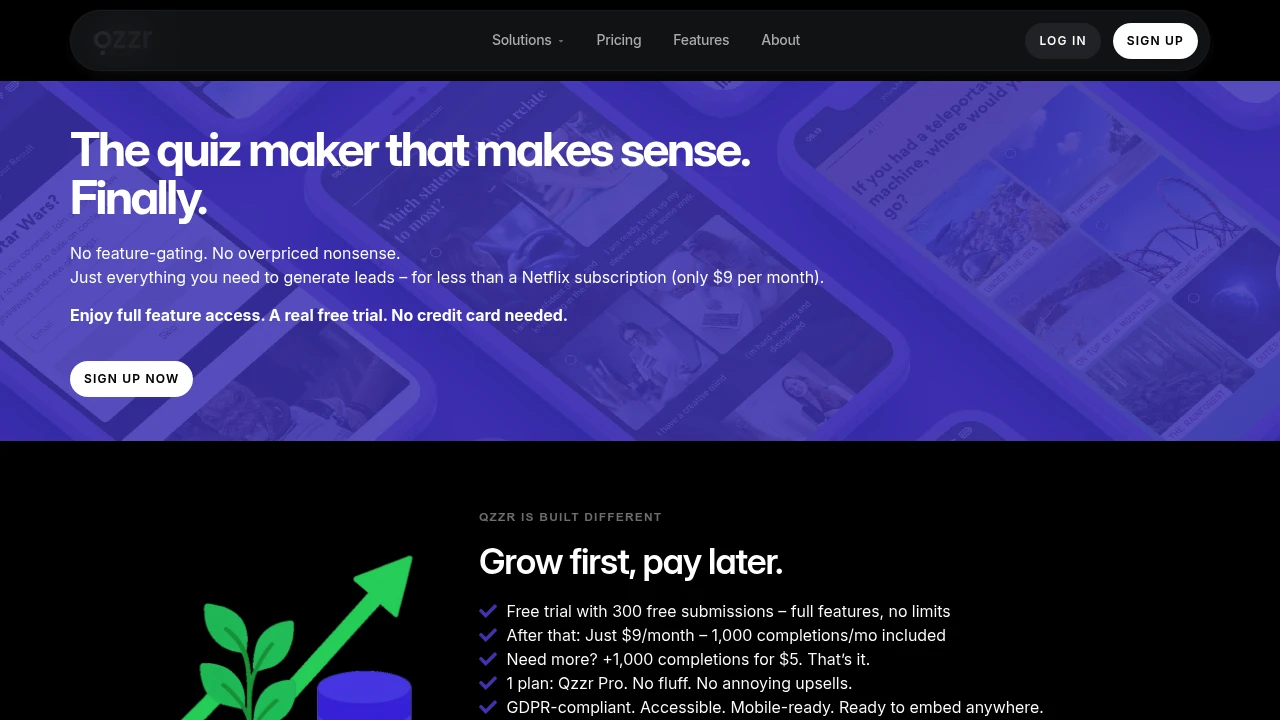
What is qzzr
Qzzr is a cloud-hosted quiz creation and distribution platform focused on content-marketing quizzes, lead generation, and audience segmentation. The product offers a browser-based editor for building personality tests, scored quizzes, and assessment flows, plus tools to capture respondent data, integrate results with marketing systems, and embed quizzes into web pages or email campaigns.
Qzzr targets marketing teams, editorial teams, course creators, and small businesses that use quizzes to increase engagement, grow email lists, and qualify leads. The platform emphasizes simple quiz construction (drag-and-drop questions, multiple-choice answers and result logic), result pages that can display different outcomes or segment labels, and tracking to measure quiz performance across social and web channels.
Operationally, Qzzr hosts quizzes, serves the embed javascript and share URLs, and provides analytics on completion rates, conversions, and respondent attributes. It supports custom branding, styling options to match site design, and conditional flows that change outcomes based on answers.
Qzzr features
What does qzzr do?
Qzzr lets teams design interactive quizzes that can be published on websites and shared on social networks. The platform supports multiple question types (single choice, multiple choice), result logic (personality outcomes or score thresholds), and branching so that subsequent questions or final outcomes depend on earlier answers.
Qzzr provides built-in lead capture fields and opt-in forms so quizzes can collect email addresses and consent. Those leads can be passed to marketing automation platforms or exported as CSV. It also offers options to gate results behind an email capture or to show results immediately without collecting data, depending on the campaign goal.
For distribution, Qzzr creates responsive embeds and shareable links, and can be deployed in marketing funnels, blog posts, or social channels. It tracks metrics such as views, starts, completions, and conversion rate to help teams optimize quiz content and placement.
Qzzr pricing
Qzzr offers these pricing plans:
- Free Plan: $0/month with limits on advanced features and exports
- Starter: $15/month (or $150/year billed annually) for basic lead capture and increased response volume
- Professional: $49/month (or $490/year billed annually) with advanced integrations, A/B testing, and priority support
- Enterprise: Contact sales for custom volume, security, and SSO options; enterprise packages typically include account management and custom SLAs
Check Qzzr's pricing tiers for the latest rates and enterprise options.
How much is qzzr per month
Qzzr starts at $15/month for the Starter plan when billed monthly. That entry price covers the basic editor, standard embed options, and limited lead-capture throughput; higher-volume or feature-rich plans are available for larger teams.
How much is qzzr per year
Qzzr costs $150/year for the Starter plan when billed annually. Annual billing typically reduces the effective monthly rate and is the recommended option for teams that plan continuous use and want predictable budgeting.
How much is qzzr in general
Qzzr pricing ranges from $0 (free) to $49+/month. The Free Plan supports minimal usage and basic publishing; the Professional plan is aimed at teams that need integrations, higher response caps, and analytics; Enterprise pricing is customized based on response volume, security needs, and integration complexity.
What is qzzr used for
Qzzr is used primarily for interactive content that drives engagement, collects contact information, and segments audiences. Marketing teams use quizzes to generate inbound leads by offering a personalized result or assessment in exchange for an email address. Editorial teams use quizzes to increase time on page and social shares.
Other common use cases include qualification of leads (pre-sales assessment quizzes), customer onboarding checks (basic readiness or product-fit assessments), and training checks for learning teams that want lightweight quizzes with immediate feedback. Quizzes are also used as survey-adjacent content to gather preferences and audience insights without the formality of a survey.
Because Qzzr includes result segmentation and tagging, businesses can route respondents into different nurture sequences or CRM lists based on quiz outcomes. That makes it useful both for top-of-funnel audience growth and for mid-funnel qualification.
Pros and cons of qzzr
Pros:
- Qzzr provides a visual editor for fast quiz creation and layout control, suitable for non-technical users who need to publish quickly.
- Built-in lead capture and native integrations reduce the amount of manual work required to move leads into marketing automation or CRM systems.
- Analytics on engagement and conversion let teams iterate on question copy and placement to improve performance.
Cons:
- Advanced customization (deep styling, custom behaviors) may require CSS/JS embedding or an Enterprise plan for white-labeling and SSO.
- High-volume usage and strict data residency or compliance needs often push teams toward an Enterprise contract, which can increase total cost.
- Compared with full-featured survey platforms, Qzzr focuses on quiz-style interactions and may lack some advanced survey question types and randomized sampling features.
Operational considerations:
- Personal Use: Qzzr's Free Plan is appropriate for one-off quizzes and simple embeds.
- Team Features: Teams should evaluate the Professional and Enterprise plans for collaboration, shared assets, and workflow controls.
- Export and Backup: Make sure the plan you choose includes CSV export or direct integration with your data store for backups and CRM syncing.
Qzzr free trial
Qzzr typically offers a free tier or trial period so teams can evaluate the quiz editor, publishing workflow, and integrations before committing. The Free Plan allows you to create and publish quizzes with basic analytics and limited responses.
During a trial or on the Free Plan, some features — such as advanced integrations, A/B testing, export limits, or custom branding — are usually disabled or limited. Trialing the Professional plan for a set period is recommended if you want to test lead-routing and API integrations under realistic response volumes.
To understand current trial details and limits, view Qzzr's pricing tiers and the account comparison that explains which features are active during the free trial or on each plan.
Is qzzr free
Yes, Qzzr offers a Free Plan. The Free Plan provides basic quiz creation, publishing, and limited analytics, which is suitable for testing the platform and running occasional quizzes. For ongoing lead capture at scale or access to integrations and export limits, paid plans are required.
Qzzr API
Qzzr provides programmatic access and webhooks so quiz responses and lead data can be forwarded to third-party systems in real time. Typical API capabilities include creating and updating quizzes, retrieving response data, and subscribing to webhook events for new submissions.
Common integration endpoints include automated delivery of respondent data to CRMs and marketing platforms, passing score/result labels as tags, and fetching analytics for custom dashboards. Webhook support makes it possible to trigger workflows in Zapier, Integromat (Make), or custom middleware when a quiz completes.
For developers, Qzzr's API documentation and developer resources explain authentication mechanisms (API keys or token-based auth), rate limits, and sample payloads for common actions. For the latest developer reference and code examples, consult the Qzzr API documentation or their integrations hub.
10 Qzzr alternatives
Paid alternatives to qzzr
- Typeform — Conversational form and quiz builder with strong design focus, conditional logic, and broad integrations for lead capture and surveys.
- SurveyMonkey — Enterprise-grade survey and quiz tools with advanced analytics and distribution controls, suitable when formal survey methodology and sampling are required.
- Interact — Quiz builder focused on lead generation and list segmentation with templates optimized for marketing campaigns.
- Outgrow — Interactive content platform including calculators, quizzes, and recommendations designed for lead generation and personalization.
- LeadQuizzes — Quiz and popup-based lead capture tool that emphasizes list growth and CRM connectors.
- ProProfs Quiz Maker — Feature-rich quiz creation with LMS-adjacent features like grading, certificates, and reporting.
- SlickQuiz (commercial add-ons) — Lightweight quiz solutions with commercial hosting options for publishers.
Open source alternatives to qzzr
- LimeSurvey — Open source survey platform that can be adapted for quiz-style interactions and hosted on your own infrastructure.
- QuizFaber (open source variants) — Desktop or self-hosted quiz engines that export web-friendly quizzes for embedding.
- QuesGen (community projects) — Community-driven quiz frameworks that provide basic quiz logic and can be integrated into custom web stacks.
- H5P — Open content collaboration framework with interactive quiz types that integrate into popular CMS and LMS platforms like WordPress and Moodle.
When comparing alternatives, consider feature differences such as conditional branching, lead-capture options, analytics depth, and the availability of native integrations to your marketing stack.
Frequently asked questions about Qzzr
What is Qzzr used for?
Qzzr is used for building interactive quizzes to generate leads and segment audiences. Marketers and publishers use it to create personality quizzes, scored assessments, and knowledge checks that can be embedded on websites or shared on social media. Results and respondent data are used to populate CRM lists, trigger automated email sequences, or inform content decisions.
Does Qzzr integrate with CRM and email platforms?
Yes, Qzzr supports integrations with common CRMs and email tools. Typical integrations include passing lead data to systems like HubSpot and Mailchimp, or using Zapier to connect to hundreds of other apps. Integration depth depends on the plan and whether webhooks or native connectors are used.
How much does Qzzr cost per month?
Qzzr starts at $15/month for the Starter plan when billed monthly. Higher-tier plans add features such as advanced integrations, higher response limits, and account controls typically needed by teams.
Is there a free version of Qzzr?
Yes, Qzzr offers a Free Plan. The Free Plan allows basic quiz creation, publishing, and limited analytics so users can test the editor and run occasional quizzes without cost.
Can Qzzr send quiz responses to Zapier?
Yes, Qzzr can forward responses to Zapier via webhooks or direct integration. This enables connecting quiz completions to actions like adding contacts to CRMs, sending Slack notifications, or creating tasks in project management tools.
Can Qzzr be white-labeled for enterprise use?
Yes, enterprise plans typically include white-labeling and custom branding. Larger customers can request custom domains, removal of platform branding, and single sign-on (SSO) as part of Enterprise agreements.
Does Qzzr offer reporting and analytics?
Yes, Qzzr provides analytics on quiz performance. You can view metrics such as impressions, starts, completions, conversion rate, and distribution of results to understand engagement and optimize quiz content.
Can I export quiz responses from Qzzr?
Yes, Qzzr allows exporting responses as CSV or sending them to connected systems. Export capabilities and report retention windows vary by plan; Professional or Enterprise plans generally include extended export and data retention features.
Is Qzzr suitable for educational assessments?
Yes, Qzzr can be used for lightweight assessments and knowledge checks. While it does not replace a full Learning Management System for graded coursework, it is appropriate for short quizzes, formative checks, and interactive learning content embedded in web pages.
How secure is data collected through Qzzr?
Qzzr follows standard web security practices and offers enterprise security options. Data in transit is encrypted and higher-tier plans provide features like SSO, custom data handling agreements, and dedicated support for compliance needs. For specific compliance certifications and data residency, consult Qzzr's security documentation.
qzzr careers
Hiring at Qzzr is typically focused on product, engineering, marketing, and customer success roles that support a SaaS product lifecycle. Common openings include front-end and back-end engineers, product designers, customer success managers, and growth marketers. Roles vary between remote and on-site depending on company policy and geographic location.
Candidates interested in engineering should emphasize experience with JavaScript-based front-end tooling, API design, and cloud-hosted services. Marketing roles tend to prioritize experience with content marketing, conversion optimization, and analytics for audience acquisition.
To find current openings and application details, review the company’s careers page or professional network listings.
qzzr affiliate
Qzzr has historically worked with partners and affiliate channels that promote quiz-driven lead generation to their audiences. Affiliate programs often provide referral links, revenue share for paid plan signups, and promotional materials for publishers.
If you are an agency or publisher interested in partnership, contact Qzzr’s sales or partnerships team to learn about the current affiliate terms, referral rates, and co-marketing support. Program availability and commission structures may change over time.
Where to find qzzr reviews
You can find user reviews and customer feedback on software directories and review sites that cover marketing technology. Look for reviews that mention quiz performance, integration reliability, and customer support responsiveness. Search for platform-specific reviews on business software marketplaces to compare user ratings and read real-world experiences.
For up-to-date testimonials and case studies, check Qzzr’s website or their customer stories section, and cross-reference with independent review sites for balanced perspectives.

Similar to Qzzr


