
Cherwell
Cherwell is an IT service management (ITSM) and enterprise service management (ESM) platform used by IT, HR, facilities, and other service teams to manage incidents, requests, changes, assets, and workflows. It supports cloud and on-premises deployment, configurable workflows, a built-in low-code configuration environment, and integrations with common IT operations and monitoring tools.
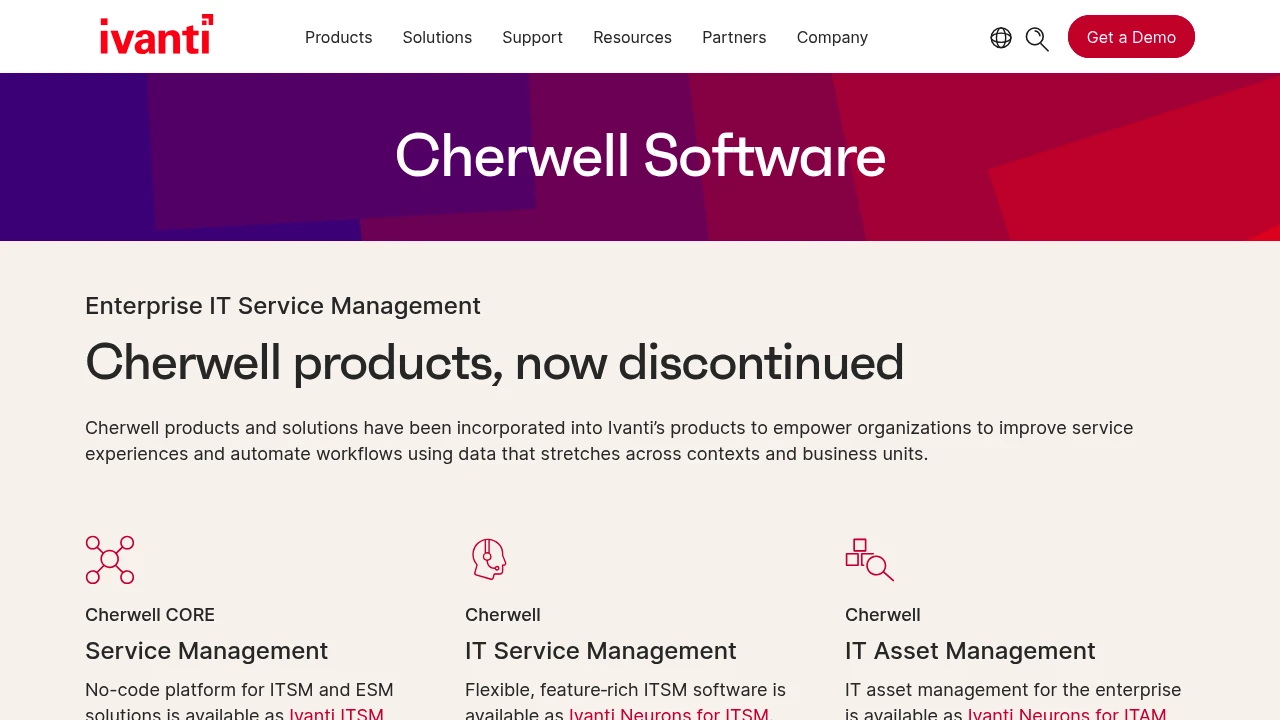
What is cherwell
Cherwell is an IT service management (ITSM) and enterprise service management (ESM) platform designed for medium and large organizations that need configurable workflows, a flexible data model, and both cloud and on-premises deployment options. The platform focuses on ITIL-based processes (incident, problem, change, request, asset and configuration management) while also extending the same service-delivery patterns to HR, facilities, and customer-facing service desks. Cherwell historically provided a combination of on-premises licenses and cloud subscription offerings and is often positioned against other enterprise ITSM suites.
Cherwell emphasizes a low-code configuration layer so administrators and process owners can adjust forms, business rules, and automation without heavy developer involvement. This design reduces the need for custom coding while allowing extensive tailoring to organizational processes. The platform includes reporting and dashboards, role-based access control, multi-tenant architecture for service providers, and options for integrating with discovery and monitoring tools.
Organizations choose Cherwell when they want a single platform to centralize service operations across multiple departments and to maintain a high degree of customization without a full professional services engagement. The platform is also used where teams require on-premises deployment for compliance or need a transition path from legacy ITSM systems.
Cherwell features
What does cherwell do?
Cherwell provides the core ITSM capabilities required to operate a service desk at scale, packaged with configuration and automation tools to adapt the product to organizational processes. Key functional areas include incident and request management, change and release governance, problem management, service catalog and request fulfillment, and a configuration management database (CMDB) for tracking assets and relationships.
Beyond basic IT service workflows, Cherwell supports enterprise use cases such as HR case management, facilities requests, legal intake, and project intake workflows. The platform contains a service catalog builder, approvals engine, configurable SLAs, and multi-channel intake (email, phone integrations, portal, and chatbots). A low-code graphical editor (often called the configuration or business object designer) lets administrators define forms, fields, transitions, and triggers without code.
Cherwell also offers reporting and analytics, automated notifications, knowledge base capabilities for self-service, role-based dashboards, and workforce management/assignment rules. For organizations concerned with compliance and security, the platform includes auditing, access controls, and options for single sign-on (SSO), multi-factor authentication (MFA), and data residency choices depending on deployment.
Cherwell pricing
Cherwell offers these pricing plans:
- Cloud Subscription: $35–$120/agent/month (typical market range; actual price custom quoted) depending on module set, number of agents, and contract term
- Perpetual License (On-premises): $10,000+ initial license fee plus annual maintenance typically 15–25% of license cost
- Business User / Self-Service: $0–$10/user/month for read-only or limited portal users in many licensing models
- Enterprise Support & Add-ons: pricing available by quote for premium support, advanced integrations, and managed services
Because Cherwell historically sells enterprise licenses and custom bundles, actual customer pricing is usually determined by scope, modules (ITSM, ITAM, ESM), deployment model, and number of administrative or agent seats. Check Cherwell's solutions and contact pages for vendor-provided details and the latest procurement information on Cherwell's official site.
View Cherwell's product pages and contact options on Cherwell's official website for current licensing and deployment choices: Cherwell's product and solutions overview (https://www.cherwell.com/).
How much is cherwell per month
Cherwell starts at approximately $35/agent/month as a common entry-level cloud subscription price in mid-market ITSM comparisons when vendors provide list guidance; enterprise discounts, multi-year contracts, and bundled modules affect the effective per-month rate. Actual monthly subscription pricing is custom quoted and may be lower for large-volume commitments or higher when advanced modules and premium support are included.
How much is cherwell per year
Cherwell can cost from about $420/year per agent to several thousand dollars per year per agent when factoring in enterprise features and support. For on-premises, initial perpetual license fees typically exceed $10,000 with an ongoing maintenance charge (commonly 15–25% of license value) which results in a multi-thousand-dollar annual commitment for production instances.
How much is cherwell in general
Cherwell pricing ranges from roughly $35/agent/month for cloud subscriptions to six-figure engagements for large, multi-department enterprise deployments. Small deployments or single-team pilots can be lower in absolute dollars, while full-service ESM rollouts with ITAM, advanced reporting, and integration services push total cost significantly higher. For an accurate assessment, request a tailored quote and proof-of-concept from the vendor.
What is Cherwell used for
Cherwell is used primarily for IT service management: logging incidents, routing and resolving service requests, coordinating changes and releases, and maintaining a CMDB to understand relationships between hardware, software, and services. These features help IT teams reduce mean time to resolution, enforce change governance, and provide consistent service levels across the organization.
Beyond IT, Cherwell is used by HR for employee onboarding and case management, by facilities for space and equipment requests, and by legal/finance for intake and approval workflows. Organizations that want a single platform to manage multiple service lines often adopt Cherwell to avoid fragmented systems and duplicated processes.
The platform's low-code configuration environment makes it useful for organizations that expect processes to evolve, want to minimize vendor-led customization costs, and require fast change cycles for forms, approvals, or automation rules. Cherwell is also chosen when teams need a mix of cloud and on-premises deployments for compliance, data residency, or integration reasons.
Pros and cons of Cherwell
Pros:
- Highly configurable low-code environment that reduces the need for custom development and professional services for many changes
- Broad ITIL-aligned feature set covering incident, problem, change, CMDB, asset management, and service catalog workflows
- Support for both cloud and on-premises deployments, which appeals to organizations with strict compliance or integration needs
- Multi-department ESM support so non-IT service teams can reuse the platform
Cons:
- Enterprise-grade functionality often comes with enterprise-grade pricing; total cost can be high for full ESM rollouts
- Deep customization, while powerful, can lead to complex configurations that require governance to maintain
- Integrations and advanced reporting may require skilled administrators or professional services for optimal implementation
Operational considerations:
- Plan for governance around configuration changes to prevent 'configuration sprawl' and ensure consistent upgradeability
- Factor in training for administrators and service owners to take full advantage of the low-code capabilities and workflow engines
- Evaluate staffing or vendor support for integrations, CMDB population, and change-management extensions
Cherwell free trial
Cherwell typically does not offer a public free tier comparable to SaaS consumer apps; trial and pilot access are often provided through a sales-driven proof-of-concept or sandbox environment. Enterprises evaluating the platform commonly receive a time-limited evaluation instance or guided trial hosted by Cherwell or a partner.
A typical pilot engagement includes access to a sandbox instance, sample data, and assistance with basic configuration to validate process fit and integration feasibility. Organizations should request a proof-of-concept that mirrors their core incident and change workflows and includes sample integrations with identity providers or monitoring tools when possible.
To arrange an evaluation, contact Cherwell through their official trial or contact channels and describe the scale and integrations you want to test. For direct vendor engagement, see Cherwell's contact and support pages on the official site.
Is cherwell free
No, Cherwell is not offered as a broadly available free product for production use. Evaluation or sandbox access is typically arranged through a proof-of-concept with the vendor or a partner. Small-scale pilots for feature validation are generally available on request rather than as an open free tier.
Cherwell API
Cherwell provides RESTful APIs and programmatic interfaces for integration, automation, and data synchronization. Typical API capabilities include creating and updating incidents and tickets, querying and updating CMDB records, executing business rules, and interacting with the service catalog. The API supports JSON payloads, OAuth or API key-based authentication, and webhooks for event-driven integration patterns.
Integration use cases include: connecting monitoring and observability platforms to auto-create incidents; synchronizing identity and HR systems for onboarding/offboarding workflows; populating the CMDB from discovery tools; and connecting configuration management databases with asset lifecycle data. Cherwell also supports connectors for Active Directory/LDAP, SAML-based SSO, and common IT operations tools.
For development and automation, Cherwell provides SDKs and a documented API surface (refer to Cherwell's developer resources). When planning integrations, validate rate limits, authentication patterns, and whether the integration should run via the cloud subscription endpoint or an on-premises gateway. For details on API endpoints and developer guides, consult Cherwell's official developer and integration documentation on their website.
10 Cherwell alternatives
- ServiceNow — Enterprise-class ITSM and ITOM platform with extensive workflow automation, strong CMDB, and a large partner ecosystem
- BMC Helix ITSM — Cloud-native ITSM suite with AI-assisted operations and deep ITOM capabilities
- Ivanti Service Manager — ITSM and asset management with strong endpoint security and unified IT operations
- Freshservice — Cloud-first ITSM for mid-market teams with simpler pricing and faster time-to-value
- ManageEngine ServiceDesk Plus — Feature-rich ITSM with built-in asset management and on-premises/cloud options
- Jira Service Management — Developer-friendly ITSM with tight integration to Jira Software and agile teams
- SolarWinds Service Desk — ITSM with a focus on asset discovery and simplified IT workflows
- Cherwell (itself) is often evaluated alongside the above vendors when organizations prioritize configuration flexibility
- SysAid — Mid-market ITSM with automation and asset management built in
- HEAT Software (Ivanti) — ITSM and service automation solutions for enterprise environments
Paid alternatives to Cherwell
- ServiceNow: Enterprise workflow and ITSM platform used by large organizations with complex requirements; high maturity and extensive partner ecosystem
- BMC Helix ITSM: Cloud-native option from BMC that includes cognitive service management features and strong ITOM integration
- Ivanti Service Manager: Combines ITSM with endpoint and asset management capabilities, often chosen by organizations consolidating IT tools
- Freshservice: Faster deployment for mid-market with intuitive UI and modern service catalogue features
- ManageEngine ServiceDesk Plus: On-premises and cloud options with integrated ITAM and affordable pricing for mid-market customers
- Jira Service Management: Best fit for engineering-led or DevOps organizations that want ITSM with deep integration to development workflows
- SolarWinds Service Desk: Focused on asset-first ITSM, suitable for organizations that want tight discovery and inventory
Open source alternatives to Cherwell
- GLPI: Open source ITSM and asset management with a modular plugin ecosystem for CMDB and ticketing
- osTicket: Lightweight open source help desk application for basic ticketing and email-to-ticket workflows
- iTop: Open source CMDB and ITIL-compliant service management platform suited for organizations that want deep customization
- Zammad: Modern open source helpdesk with web UI, multi-channel ticketing, and REST API integrations
- OTRS (Community forks): Historically used for event-driven ticketing and service operations; community forks and derivatives continue in some environments
Frequently asked questions about Cherwell
What is Cherwell used for?
Cherwell is used for IT service management and enterprise service management. Organizations use it to run incident, problem, change, request, and asset workflows, and to extend service management to HR, facilities, and other internal service teams. The platform centralizes service intake, automates approvals, and tracks SLAs across multiple service lines.
Does Cherwell offer cloud and on-premises deployments?
Yes, Cherwell supports both cloud subscription and on-premises deployments. Customers can choose a SaaS model for faster deployments or an on-premises/perpetual license model for data residency and compliance requirements. The deployment choice impacts integration patterns and operational responsibilities.
How much does Cherwell cost per agent per month?
Cherwell pricing commonly ranges from about $35 to $120 per agent per month depending on the modules, contract terms, support level, and enterprise discounts. Actual per-agent costs are custom quoted by the vendor and vary with deployment model and included functionality.
Is there a free version of Cherwell?
No, Cherwell does not have a broadly available free production tier. Evaluation access or sandbox trials are typically provided through a vendor-led proof-of-concept or partner engagement rather than an open free edition.
Can Cherwell integrate with monitoring and discovery tools?
Yes, Cherwell integrates with monitoring, discovery, and identity systems. Integrations commonly include event ingestion from monitoring platforms, CMDB population from discovery tools, SSO via SAML/LDAP, and connectors for email, IT automation, and collaboration tools.
Does Cherwell provide a REST API?
Yes, Cherwell provides RESTful APIs and webhook capabilities. The API allows programmatic ticket creation, CMDB queries, updating records, and triggering workflows; it supports common authentication mechanisms and is used for automations and third-party integrations.
Can Cherwell be used outside of IT?
Yes, Cherwell can be extended to HR, facilities, legal, and other service teams. The platform's low-code configuration tools and service catalog enable non-IT departments to implement case management, request fulfillment, and workflow automation on the same underlying system.
How secure is Cherwell?
Cherwell supports enterprise-grade security features such as role-based access control, auditing, SSO integration, and options for data residency depending on deployment. For specifics on certifications and compliance posture, review Cherwell's security documentation or contact their security team.
How long does it take to implement Cherwell?
Implementation time varies from weeks to several months depending on scope. A basic ITSM pilot with incident and request workflows can be implemented quickly, while full ESM rollouts with CMDB population, integrations, and custom automations typically require a multi-month project and change-management effort.
What training and support options are available for Cherwell?
Cherwell offers vendor-led training, documentation, and partner services for implementation and support. Training ranges from administrator and developer courses to end-user training, and premium support or managed services are available by contract to accelerate deployments and ensure operational continuity.
cherwell careers
Cherwell and its partner ecosystem historically recruit for roles in product management, engineering, implementation consulting, and customer success. Career paths often include ITSM product specialists, integration engineers, solution architects, and professional services consultants who implement and maintain service management solutions. Check Cherwell's corporate pages and partner job boards for current openings and role descriptions.
cherwell affiliate
Cherwell partners with systems integrators and technology providers who resell, implement, and support the platform. Affiliate and partner programs typically offer training, certification, and go-to-market support for consultancies. For partnership inquiries, use the contact and partner pages on Cherwell's official site to identify authorized resellers and certified implementation partners.
Where to find cherwell reviews
Find user reviews and comparative feedback on enterprise software review sites, analyst reports, and community forums. Look for Cherwell reviews and customer case studies on industry sites and platforms that focus on ITSM. For vendor-provided case studies, visit Cherwell's customer stories and resources pages on their official website.

Similar to Cherwell


