
Simplesat
Customer satisfaction (CSAT) survey platform for support teams, product managers, and SaaS companies. Simplesat collects short, contextual feedback via email, chat, or embedded widgets and routes results into helpdesk, CRM, and analytics tools for SLA tracking, quality assurance, and product insights.
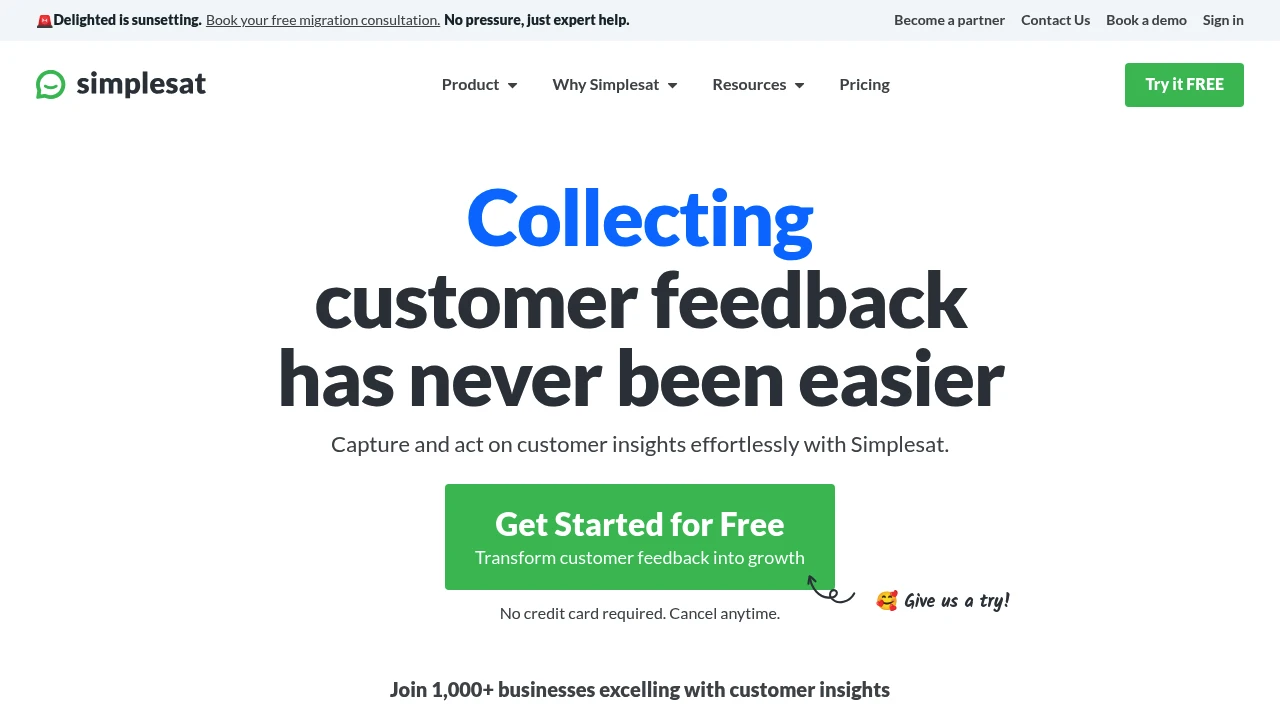
What is simplesat
Simplesat is a focused customer feedback platform that helps support teams and product teams collect and act on short satisfaction surveys. The product is designed to capture CSAT, NPS, and CES-style metrics at the point of customer contact — for example after a support ticket is closed, following a chat conversation, or inside a product experience. Responses are lightweight (one- or two-question surveys) so response rates are typically higher than with long-form surveys.
Simplesat is mainly used by customer support, customer success, and product organizations that need to measure qualitative and quantitative satisfaction at scale without interrupting workflows. It emphasizes fast deployment, pre-built integrations with common helpdesk tools, and APIs/webhooks so teams can attach feedback to tickets, users, and accounts in their existing systems.
Typical deployments include adding satisfaction widgets to ticket close messages, sending follow-up email surveys after interactions, embedding feedback prompts inside web apps, and using CSAT as an operational metric for agent performance and product prioritization.
For official implementation details and the latest product pages, check Simplesat's product documentation and guides.
Simplesat features
What does simplesat do?
Simplesat provides a compact set of features focused on collecting, routing, and analyzing short customer feedback. Core capabilities include:
- Survey creation and templating: quick-to-deploy CSAT, NPS, and CES surveys that can be customized with company branding and language.
- Multi-channel delivery: email surveys, embeddable widgets for web and in-app experiences, and integrations that trigger surveys from support systems.
- Integrations and routing: native connectors and webhooks that attach survey results to tickets, user records, or CRM objects for downstream workflows.
- Reporting and dashboards: aggregated satisfaction metrics, historical trends, and agent-level reporting for operational tracking.
Beyond those basics, Simplesat supports conditional logic for survey follow-ups, response metadata (tags, custom fields), and team queuing: you can route specific surveys to particular products, teams, or agents. It also includes export options (CSV/JSON) and role-based access for admins and managers.
Simplesat emphasizes minimal friction: short surveys, simple embeds, and direct ticket/agent association so feedback is actionable without extensive survey design or heavy analytics configuration.
Simplesat pricing
Simplesat offers these pricing plans:
- Free Plan: $0/month — basic survey widgets and email surveys with limited monthly responses and core reporting
- Starter: $29/month — increased monthly response allowance, multiple integrations, and basic automated reporting (billed annually at $290/year)
- Professional: $79/month — higher response caps, advanced reporting and filtering, SSO, and priority support (billed annually at $790/year)
- Enterprise: Custom pricing — unlimited responses, SAML SSO, dedicated onboarding, SOC/ISO support, and contract terms
Monthly and annual pricing options are common: monthly plans are billed month-to-month while annual billing typically provides a multi-month discount when paid upfront. Check Simplesat's current pricing plans for the latest rates, response limits, and enterprise options.
How much is simplesat per month
Simplesat starts at $0/month with the Free Plan that includes limited responses and basic survey widgets. Paid plans begin at $29/month for teams that need higher response volumes and professional features. Monthly billing is available for Starter and Professional tiers; Enterprise is quoted individually.
How much is simplesat per year
Simplesat costs $290/year for the Starter plan when billed annually (equivalent to two months free versus monthly billing) and $790/year for the Professional plan under annual billing. Enterprise customers receive custom annual contracts tailored to response volume and compliance needs.
How much is simplesat in general
Simplesat pricing ranges from $0 (free) to custom enterprise contracts (commonly $29–$79/month for mid-market teams). The primary cost drivers are monthly response allowances, number of integrations required, and security/compliance features such as SAML/SSO and custom data retention. Larger organizations or those with strict compliance needs typically move to Enterprise plans with personalized pricing.
What is simplesat used for
Simplesat is used to measure customer sentiment immediately after interactions with support, success, or product flows. It’s useful for operational metrics (CSAT by agent, queue, or product), for monitoring trends after product releases, and for collecting contextual feedback to prioritize fixes or improvements.
Operational use cases include using CSAT as a quality metric on a customer support dashboard, triggering follow-up tickets or tasks for low scores, and aggregating feedback by product area to inform roadmaps. Product teams use in-app widgets to collect feedback tied to specific features or workflows, enabling rapid, contextual insight from active users.
Teams also use Simplesat for SLA monitoring — for example, to detect when satisfaction drops below a threshold after critical incidents — and for coaching: agent-level CSAT ensures training targets are objective and tied to customer outcomes.
Pros and cons of simplesat
Pros:
- Short, focused surveys yield higher response rates than long-form surveys and are easier to embed in workflows.
- Wide set of helpdesk and productivity integrations makes it simple to attach feedback to tickets and user records.
- Flexible delivery options (email, widgets, chat triggers) mean you can capture feedback at the most relevant moment.
- Reporting focuses on operational metrics — agent, queue, and product-level views that are immediately actionable.
Cons:
- Purpose-built for short transactional feedback; it is not a full-featured survey platform for complex research studies.
- Larger enterprises with strict data residency needs may require custom contracts and additional compliance work.
- If you need heavy multivariate analytics or advanced segmentation, you may need to pipeline exports into dedicated BI tools.
Operationally, Simplesat trades breadth for simplicity: teams that need lightweight, actionable CSAT will benefit, while teams that need long-form research or advanced behavioral analytics will need complementary tools.
Simplesat free trial
Simplesat provides a free tier that lets teams evaluate survey widgets and basic reporting without a credit card. Paid plans typically come with a trial period (commonly 14 days) so you can test higher response volumes, integrations, and reporting features before committing. The free tier is useful for proof-of-concept work — you can embed a widget, send email follow-ups, and see initial reporting right away.
During a trial, you should test the full workflow: trigger a survey from your helpdesk, verify that responses attach to the correct ticket or user record, and confirm that reporting and exports meet your operational needs. For enterprise trials, Simplesat’s onboarding includes help with integration mapping, SSO setup, and response volume planning.
Is simplesat free
Yes, Simplesat offers a Free Plan. The Free Plan provides limited monthly responses, basic survey templates, and core widgets suitable for individual users or small teams wanting to validate the approach. Larger teams will typically upgrade to a paid plan for higher response caps, advanced reporting, and SSO.
Simplesat API
Simplesat provides a REST-based API and webhook system that lets you programmatically create surveys, fetch responses, and attach metadata to results. Common API workflows include:
- Creating a survey instance and retrieving a unique survey URL to embed in emails or app flows.
- Submitting a response programmatically when an interaction completes (for example, on ticket close events).
- Querying response history for custom reporting or to feed into BI systems.
Webhooks allow real-time delivery of responses into downstream systems such as queue processors, CRM updates, or analytics pipelines. SDKs and client examples are provided in the developer documentation for common languages and platforms.
For full technical details, authentication methods, rate limits, and example requests, see the Simplesat developer documentation which lists endpoints for surveys, responses, webhooks, and account configuration.
10 Simplesat alternatives
- Delighted — Lightweight CX platform for NPS and CSAT with a strong email and SMS feature set.
- Wootric — Survey tooling focused on in-product NPS and CSAT for SaaS companies.
- AskNicely — NPS and customer feedback platform with strong CRM integration options.
- Zendesk — Full helpdesk with built-in satisfaction surveys and deeper ticketing features.
- SurveyMonkey — Broad survey platform suitable for long-form research and large-scale studies.
- Typeform — Flexible forms and surveys with conversational UI for higher engagement.
- Hotjar — Behavioral analytics with feedback widgets and session recordings for product teams.
- Intercom — Messaging-first product that also supports in-app surveys and customer feedback collection.
- HubSpot Service Hub — Customer service suite that includes CSAT surveys tied to CRM records.
- Freshdesk — Helpdesk platform with built-in survey options and automation capabilities.
Paid alternatives to simplesat
- Delighted: Simple NPS/CSAT delivery with email, SMS, and web widgets and advanced reporting options.
- Wootric: Focused on in-app and email-based NPS and CSAT with journey-based triggers and ML for text feedback.
- AskNicely: NPS-centric platform with automated distribution and CRM-focused workflows.
- Zendesk: Offers satisfaction ratings inside a full helpdesk environment with workflows and SLAs.
- Intercom: Combines messaging and in-app surveys with automation and customer data for contextual feedback.
Open source alternatives to simplesat
- LimeSurvey: Self-hosted survey platform for full control over form logic, design, and data residency.
- Mautic: Open-source marketing automation that can be extended to send and collect survey data via email and web forms.
- Formbricks: Open-source form backend and widget system that can be used for embedded feedback collection.
- Question2Answer: Community-driven Q&A platform that can be adapted for feedback collection in self-hosted setups.
Frequently asked questions about Simplesat
What is Simplesat used for?
Simplesat is used for collecting short customer satisfaction surveys (CSAT, NPS, CES) at the point of interaction. Teams use it to measure support quality, track trends after product releases, and attach feedback to tickets or customer records for operational actions.
Does Simplesat integrate with Zendesk?
Yes, Simplesat offers a native Zendesk integration. It can automatically send a survey when a ticket is closed, attach responses to the ticket, and provide agent-level reporting inside your Zendesk workflows.
How much does Simplesat cost per month?
Simplesat starts at $0/month with the Free Plan; paid plans begin at $29/month for the Starter tier. Pricing depends on response volume, integrations, and enterprise features like SSO and data retention.
Is there a free version of Simplesat?
Yes, Simplesat has a Free Plan. The Free Plan includes core survey widgets and basic reporting with limits on monthly responses, which is useful for small teams or proof-of-concept tests.
Can Simplesat be used for in-app surveys?
Yes, Simplesat supports embeddable widgets and in-app survey prompts. You can place lightweight feedback widgets inside web apps or product flows and tie responses back to user accounts for contextual analysis.
What integrations does Simplesat support?
Simplesat integrates with major helpdesks, CRMs, and automation tools. Common integrations include Zendesk, Freshdesk, Intercom, Help Scout, HubSpot, Salesforce, and productivity tools via Zapier and webhooks for custom integrations.
Does Simplesat have an API?
Yes, Simplesat provides a REST API and webhooks for programmatic access. The API supports creating surveys, submitting responses, retrieving response history, and subscribing to webhook events for real-time workflows.
How secure is Simplesat?
Simplesat provides standard SaaS security controls including SSL/TLS encryption and role-based access. Enterprise plans add SSO/SAML and additional contractual security controls; contact Simplesat for details on SOC/ISO certifications and data residency options.
Can I export Simplesat data for BI analysis?
Yes, Simplesat supports exports and API access for downstream analysis. You can export CSV/JSON of responses or use the API/webhooks to stream responses into a data warehouse or BI tool for advanced segmentation and reporting.
How is Simplesat different from SurveyMonkey?
Simplesat focuses on short transactional feedback tied to support workflows, while SurveyMonkey targets long-form research and complex surveys. Simplesat is optimized for integration with ticketing systems and rapid operational reporting; SurveyMonkey provides more advanced survey logic, sampling, and research features.
simplesat careers
Simplesat typically lists engineering, product, and customer success roles on their careers page. Candidates interested in customer feedback platforms should look for roles in backend engineering (API and integrations), frontend (widgets and embeds), and customer success where product and support intersect. For the latest openings and hiring process details, review the Simplesat careers page.
simplesat affiliate
Simplesat runs partner and referral programs for agencies and consultants who specialize in customer experience, helpdesk deployment, or SaaS integrations. Affiliate or partner tiers usually include referral credits, co-marketing materials, and onboarding assistance for referred customers. Contact Simplesat’s partnerships team via their website to get program terms and sign-up details.
Where to find simplesat reviews
You can find Simplesat reviews on popular SaaS review sites and product directories. Look for customer testimonials and ratings on platforms such as G2, Capterra, and TrustRadius for real-world feedback on integration quality, support responsiveness, and value for money. Also check community forums and developer threads for integration notes and troubleshooting tips.

Similar to Simplesat

