
Surveysensum
SurveySensum is a customer experience (CX) and survey platform for product teams, customer success, and marketing. It provides survey collection across web, email, and in-app channels, automated analytics (NPS, CSAT, CES), sentiment and text analysis, and workflow automation to route feedback to the right teams. The platform is aimed at organizations that need continuous feedback loops, product improvement signals, and closed-loop resolution processes.
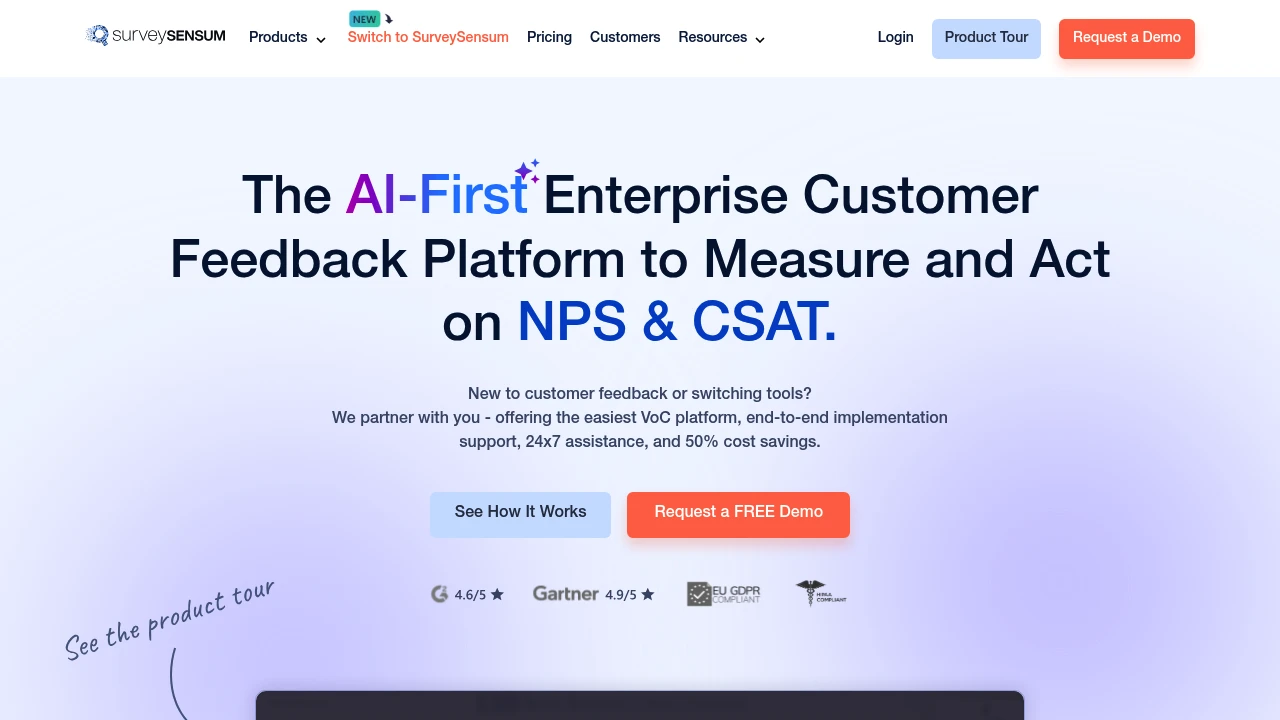
What is surveysensum
SurveySensum is a SaaS customer feedback and experience analytics platform that helps teams collect, analyze, and operationalize user feedback across multiple channels. It centralizes responses from NPS, CSAT, CES, and custom surveys, enriches them with automated sentiment analysis and topic tagging, and converts qualitative feedback into prioritized product and support tasks. The platform is used by product managers, UX researchers, customer success teams, and growth teams to measure experience metrics and drive outcome-focused improvements.
SurveySensum combines survey distribution (email, in-app, web, SMS), real-time dashboards, and integrations with common collaboration and support tools so feedback can be routed into existing workflows. It emphasizes automated analytics — for example, identifying rising themes in open-text responses and highlighting at-risk accounts based on NPS trends. It also includes closed-loop workflows to assign owners, track corrective actions, and measure the impact of interventions over time.
Designed to work at scale, SurveySensum supports multi-channel sampling, segmentation by user attributes (plan, region, product usage), and cohort-level analysis. Teams can configure triggers (e.g., product events or account attributes) to automatically send surveys and build dashboards that combine feedback with product telemetry or CRM signals.
SurveySensum features
What does SurveySensum do?
SurveySensum collects customer feedback across channels and turns that feedback into operational insights. It supports standard experience metrics — Net Promoter Score (NPS), Customer Satisfaction (CSAT), and Customer Effort Score (CES) — plus customizable surveys. Surveys can be deployed via email, in-app widgets, web intercepts, and SMS, enabling measurement at the right touchpoints in the customer journey.
The platform applies text analysis and sentiment scoring to open-ended responses to surface recurring issues and feature requests automatically. It also offers topic clustering and root-cause identification so teams can find the most frequent friction points without manual coding of responses. These analytic outputs feed into dashboards, automated alerts, and workflows so owners can act on feedback quickly.
Operational features include automated routing (create tickets in support or assign tasks to product owners), escalation workflows for detractors, and SLA tracking for response and resolution. Dashboards are configurable with segment-level filters, trend charts, and correlation tools that map feedback signals to product events, usage metrics, and account health scores.
Other notable capabilities:
- Survey builder and templates: drag-and-drop composer with templates for NPS, onboarding, renewal intent, and feature validation.
- Multi-channel distribution: email scheduling, in-app micro-surveys, website intercepts, and SMS campaigns.
- Text analytics: sentiment analysis, keyword extraction, topic modeling, and leaderboards for common themes.
- Workflow automation: closed-loop follow-up, ticket creation, Slack/Teams notifications, and custom webhooks for downstream systems.
- Segmentation and targeting: filter surveys by account, product plan, user behavior, or custom attributes.
- Dashboards and reporting: shareable dashboards, exportable reports, and API access for custom BI integrations.
SurveySensum pricing
SurveySensum offers these pricing plans:
- Free Plan: $0/month with limitations — basic NPS/CSAT surveys, limited responses per month, and access to standard dashboards suitable for single users or small teams.
- Starter: $49/month (monthly) or $39/month when billed annually ($468/year). Includes higher response volumes, email and web distribution, basic sentiment analysis, and standard integrations.
- Professional: $199/month (monthly) or $159/month when billed annually ($1,908/year). Adds in-app surveys, advanced text analytics, automated workflows, cohort reporting, and priority support.
- Enterprise: Custom pricing — includes SSO, dedicated account management, advanced security and compliance features, custom SLAs, and on-premises export options.
Pricing includes per-response or per-seat considerations depending on the plan; higher-volume accounts should expect custom quotes under the Enterprise tier. Check SurveySensum's current pricing tiers for the latest rates and enterprise options.
How much is surveysensum per month
SurveySensum starts at $0/month with the Free Plan. For teams that need more volume and analytics, the Starter plan is $49/month billed monthly or $39/month when billed annually. The Professional plan is $199/month if billed monthly and drops to $159/month with annual billing.
How much is surveysensum per year
SurveySensum costs $468/year for the Starter plan when billed annually ($39/month × 12). The Professional annual option is $1,908/year ($159/month × 12). Enterprise plans are billed annually with custom contracts and can include usage-based add-ons and onboarding fees.
How much is surveysensum in general
SurveySensum pricing ranges from $0 (free) to $199+/month per workspace depending on plan, response volume, and add-on features. Small teams and startups can begin on the Free Plan and upgrade to Starter for more responses and basic analytics, while mid-market and enterprise customers generally select Professional or negotiate Enterprise agreements for advanced security, integrations, and SLA commitments.
What is surveysensum used for
SurveySensum is used to measure and improve customer experience at scale. Product teams use it to validate features, prioritize the backlog based on customer sentiment, and measure the impact of releases on user satisfaction. Customer success teams rely on NPS and CSAT signals to identify at-risk accounts and to trigger outreach workflows.
Marketing and growth teams use surveys for campaign feedback, content validation, and measuring messaging resonance across segments. Support teams integrate SurveySensum with ticketing systems to turn detractor feedback into support tickets and to track resolution effectiveness.
It’s also used for continuous research programs: recruiting respondents for UX studies, running pulse surveys for employee experience, and validating hypotheses with targeted cohorts. The combination of analytics and automation allows teams to close the feedback loop and measure remediation outcomes over time.
Pros and cons of surveysensum
SurveySensum delivers consolidated feedback and automated analysis, which reduces manual effort of reading open-text responses and accelerates insight-to-action cycles. It integrates with collaboration and support tools, enabling closed-loop follow-up and accountability for customer issues. The multi-channel collection options give teams flexible ways to reach users where they interact with the product.
On the downside, companies with very large response volumes or specialized regulatory requirements may need Enterprise contracts and custom pricing. The initial learning curve for building automated workflows and configuring advanced text analytics can be non-trivial for teams without prior CX tooling experience. Some organizations also prefer tools with deeper built-in product analytics and may pair SurveySensum with analytics platforms to correlate feedback with behavioral metrics.
For teams deciding between broader CX suites and focused survey platforms, SurveySensum’s strength is in text analytics and operational workflows; if your priority is embedded product analytics, you may need to combine it with a product analytics tool. Implementation requires thoughtful segmentation and tagging to avoid noisy dashboards and ensure signals are actionable.
SurveySensum free trial
SurveySensum typically offers a free tier for initial exploration and may provide time-limited trials of paid features for new accounts. The Free Plan allows teams to send basic surveys and evaluate dashboards and standard analytics without a paid commitment. Free-tier users can validate distribution channels and basic NPS workflows before upgrading.
Paid trials for Starter or Professional tiers are often available on request; these trials let teams test multi-channel distribution, advanced text analysis, and automation workflows with real response volumes. Trials are useful for proving ROI (for example, showing how NPS improvements correlate with churn reduction) before entering an annual contract.
For enterprise buyers, vendor-led proofs of concept (POCs) are common and include integration with support/CRM systems, short-term volume increases for pilot cohorts, and custom reporting to demonstrate operational fit. Contact the vendor to request a trial or POC tailored to your use case and data needs.
Is surveysensum free
Yes, SurveySensum offers a Free Plan that includes basic NPS/CSAT surveys, limited responses per month, and access to standard dashboards. The free tier is meant for evaluation and small teams; upgrading unlocks higher response volumes, advanced analytics, and workflow automation.
SurveySensum API
SurveySensum provides RESTful API endpoints and webhook support to automate survey creation, distribute surveys, retrieve response data, and integrate feedback into downstream systems. Typical API capabilities include creating and managing surveys programmatically, fetching response metadata, and pulling enriched analytics (sentiment scores, extracted topics) for custom reporting.
Webhooks allow real-time delivery of response events to external systems (e.g., create a ticket in a helpdesk when a detractor responds). The API also supports exporting raw responses and aggregated metrics for ingestion into BI systems or data warehouses. API authentication uses API keys or token-based methods with scoped access for security.
For developers, the API documentation includes examples for common languages and use cases, such as automating lifecycle surveys on product events, syncing respondent profiles with a CRM, and bulk-exporting survey results for machine learning workflows. View the SurveySensum API documentation and integration guides for exact endpoint definitions, rate limits, and authentication details.
10 SurveySensum alternatives
When evaluating alternatives, consider whether you need tighter product analytics, broader CX suites, or lighter-weight survey tools. Below are ten alternatives grouped by paid and open-source options.
Paid alternatives to surveysensum
- Qualtrics — Enterprise-grade XM platform with advanced research tools, survey logic, and enterprise security. Strong for large-scale experience programs and academic research.
- Medallia — Experience management platform that centralizes feedback across touchpoints with robust enterprise features and professional services.
- Typeform — Conversational survey builder focused on user-friendly forms and flexible integrations; better for marketing and lightweight research.
- Hotjar — Behavioral analytics plus qualitative feedback tools (surveys & session recordings) targeting product and UX teams.
- SurveyMonkey — Widely used survey platform with a broad template library, enterprise plans, and integration capabilities.
- Zendesk Explore — If your primary use is support feedback, Zendesk’s reporting and satisfaction tools integrate tightly with ticketing workflows.
- Intercom — Offers in-app messaging and simple surveys ideal for product-led growth teams wanting contextual feedback inside the product.
Open source alternatives to surveysensum
- LimeSurvey — Full-featured, self-hosted survey platform with complex survey logic and export capabilities; best for organizations that require data residency control.
- FormBuilder (open-source projects like OhMyForm) — Lightweight form and survey builders that can be self-hosted for basic survey needs and ownership of data.
- Metabase — Not a survey tool but an open-source BI option to which you can export responses for analysis and visualization; useful if you prefer custom reporting over built-in analytics.
Frequently asked questions about SurveySensum
What is SurveySensum used for?
SurveySensum is used for collecting and analyzing customer feedback to measure NPS, CSAT, CES, and open-text sentiment. Teams use it to prioritize product improvements, identify at-risk accounts, and automate follow-up processes. It centralizes multi-channel feedback so stakeholders can act on insights quickly.
Does SurveySensum integrate with Slack?
Yes, SurveySensum integrates with Slack. You can send notifications about survey responses, receive alerts for detractors, and route feedback into specific channels so teams can triage issues in real time.
How accurate is SurveySensum sentiment analysis?
SurveySensum provides automated sentiment scoring with reasonable accuracy for operational use. The platform uses a combination of lexical analysis and machine learning to surface positive, negative, and neutral tones; however, accuracy improves with custom training and manual review for domain-specific language.
Can I export data from SurveySensum?
Yes, SurveySensum supports export of raw responses and aggregated reports. Exports are available through the UI and via API for ingestion into BI tools or data warehouses for custom analysis.
Is SurveySensum HIPAA compliant?
SurveySensum can support compliance needs under Enterprise contracts. For regulated data like healthcare, organizations should work with vendor sales to enable required contracts, data processing addendums, and controls.
Does SurveySensum provide single sign-on (SSO)?
Yes, SSO is available for Enterprise customers. SSO integration helps with centralized identity management, easier onboarding, and enforcing enterprise authentication policies.
Can SurveySensum trigger workflows in my helpdesk?
Yes, SurveySensum can create tickets and trigger workflows via integrations and webhooks. Common patterns include creating helpdesk tickets for detractor responses and updating CRM records with survey scores.
How many survey responses can SurveySensum handle?
SurveySensum supports thousands to millions of responses depending on plan and contract. The platform scales with usage and offers custom pricing for very high-volume customers or those needing SLA-backed throughput.
Does SurveySensum offer templates for NPS and CSAT?
Yes, SurveySensum includes ready-made templates for NPS, CSAT, CES, and common product research surveys. Templates speed up launch time and follow best practices for question phrasing and follow-up flows.
What kind of reporting does SurveySensum provide?
SurveySensum provides configurable dashboards, trend charts, cohort analysis, and topic-level breakdowns. Reports can be shared as links, exported as CSV/PDF, or consumed via API for custom BI and executive reporting.
### surveysensum careers
SurveySensum hires across product, engineering, customer success, and analytics roles. Public job listings and application instructions are typically posted on the company website and on major job boards. Candidates interested in CX, NLP, and data-driven product work should look for roles that emphasize analytics and customer engagement.
### surveysensum affiliate
SurveySensum may offer partner or referral programs for consultants, agencies, and resellers. Affiliates typically receive a referral fee or discounted seats when bringing new customers. Check the vendor’s partner program pages for program details and sign-up instructions.
### Where to find surveysensum reviews
User reviews for SurveySensum can be found on software review sites and professional communities. Look for detailed customer accounts on platforms like G2 and Capterra, and for technical discussion and implementation notes on community forums. You can also read case studies and testimonials on the vendor’s site to see examples of use cases and outcomes.

Similar to Surveysensum

